
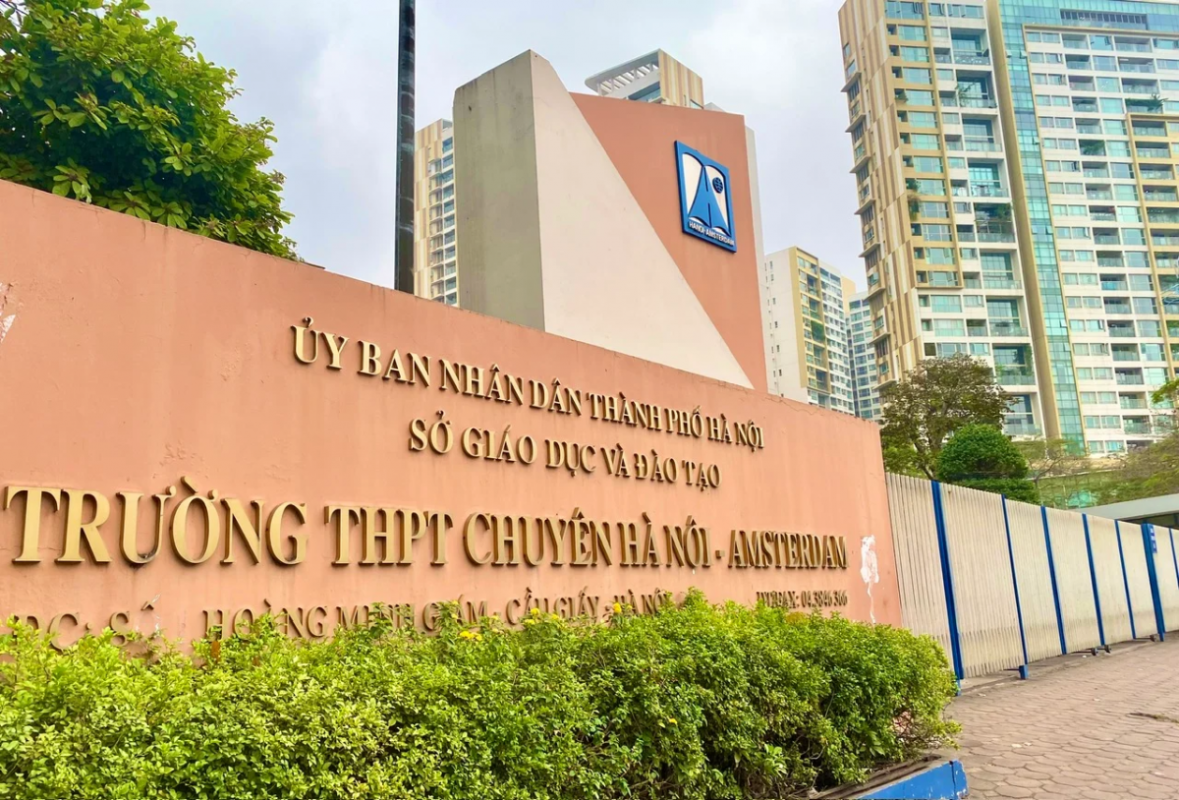
(Photo: Hanoi – Amsterdam High School. Source: Online)
Reading the project proposal to bring Hanoi – Amsterdam High School up to international standards, I feel both joy and sorrow.
I am glad because state leaders have genuinely cared about the development and competitiveness of a prestigious high school and dared to make substantial investments. This is a breakthrough in mindset. My sincere gratitude goes to the Leadership of Hanoi City for making such a monumental policy decision.
However, I am sad because the Project remains far too modest in its vision. The KPIs/OKRs set forth in the Project are, in reality, OKRs from 15 to 20 years ago. The current KPIs/OKRs established by the City have already been fully met by the School, and even far exceeded.
Hanoi – Amsterdam’s current reputation has already reached major universities around the world and is highly regarded by their admissions boards. The quality of the School’s students is already approaching parity with major high schools globally, let alone ordinary international schools. (Those international schools stand no chance of competing with Hanoi – Amsterdam. Placing the School on par with generic international schools is actually a painful downgrade, rather than an encouragement or a grand objective.)
Therefore, if we are to invest in and develop Hanoi – Amsterdam High School, we should embrace a different vision. Boldness. Decisiveness. And far more worth pursuing. Much like the vision for our nation’s current development.
Over the next 20 to 30 years, national competitiveness will increasingly boil down to a competition for talent. Vietnam will travel much further if it possesses truly world-class schools to train exceptional generations of leaders. A school like Hanoi – Amsterdam, if granted the right mechanisms and set with the right ambitions, is fully capable of becoming such an institution.
If I were to be consulted, I would advise (and desire) the following vision and OKRs for Hanoi – Amsterdam High School over the next 25 years:
1. BENCHMARKing for Learning
a) Brooklyn Technical High School and The Bronx High School of Science in New York, USA (public schools);
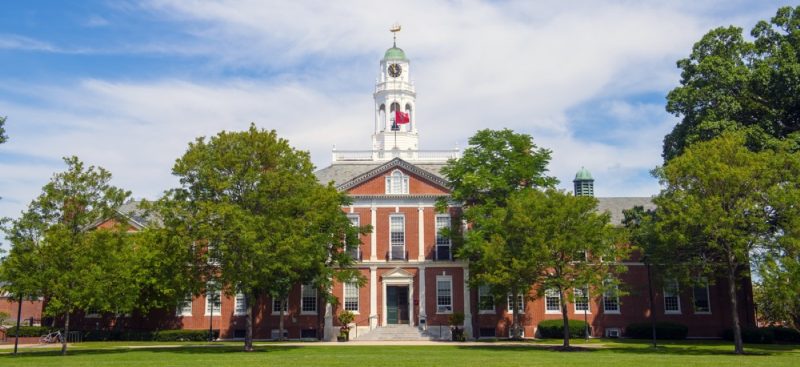
b) Phillips Andover Academy or Phillips Exeter Academy in the USA (private schools);
c) An acceptance rate of approximately 8%, of which 3% comes from portfolio/application reviews and 5% from competitive examinations.
Reason: These are world-renowned high schools in the United States. Hanoi – Amsterdam High School must stand shoulder to shoulder with the most prestigious public and private schools in the United States, not merely generic international ones.
The School should also not admit students purely based on competitive examinations, as diversity is essential: sports, arts, children from families with traditions in politics, business, academia, or the arts.
Portfolio review does not mean privilege; rather, it serves to recruit students who are truly exceptional in sports, arts, research, social leadership, or those with extraordinary achievements outside testing—individuals capable of creating a major impact, contributing to society, and returning to contribute to the school over the long term.
2. OKRs FOR FACULTY
a) 100% of full-time faculty hold a master’s degree or higher;
b) 80% hold a Ph.D., of which 80% earned their Ph.D. from top 100 universities globally and top 50 in the USA;
c) The remaining 20% of faculty are national-level athletes or Merit Artists;
d) Explicitly specify the target universities from which Hanoi – Amsterdam wants its Ph.D. faculty to graduate, such as: Harvard, Yale, MIT, Stanford, NYU, Caltech, U.Chicago, Oxford, Cambridge, Tsinghua, and Peking University;
e) Teacher/faculty salaries at Hanoi – Amsterdam High School are 3 times higher than average external teacher salaries. For instance, if the average teacher salary is 30 million VND, the salary for a teacher at Hanoi – Amsterdam must be around 90 million VND;
f) Adjunct/guest faculty must include outstanding entrepreneurs, famous artists, and elite athletes.
Reason: Faculty quality must be exceptionally high to produce outstanding students and attract top-tier teachers. We cannot rely on “rice and salt” compensation forever. If we want world-class high school teachers, we must pay salaries competitive with higher education and the corporate sector.
Salaries for Hanoi – Amsterdam faculty must be high enough that they are willing to forego the opportunities and prestige of university professorships to teach at the high school level. At the same time, high pay limits moonlighting and tutoring on the side, allowing them to dedicate their whole heart and mind to teaching and supporting students.
3. OKRs FOR SCHOOL LEADERSHIP
a) 100% of leaders from the vice-principal level upward must hold a Ph.D. and have completed advanced studies abroad;
b) School leadership must be nationally and regionally recognized for their caliber and grand vision—bold in thought, bold in execution, and fearless facing challenges. Furthermore, for a school like HN-Amsterdam to make a true leap, the Principal must possess sufficient political stature and influence within the system to protect the school’s major strategic directions.
The Principal should be appointed for at least a (5+5) year model and undergo an extremely rigorous selection process.
c) The School must have an Advisory Board or Board of Trustees (if Vietnamese law permits) consisting of eminent figures in academia, politics, and business. This Board will operate similarly to the Board of Trustees at non-profit schools in the US. The Chairman of the Board should be a retired politician of the “Four Pillars” level who was widely respected while in office.
Reason: An outstanding school must have outstanding leaders with time to execute their strategic visions. The school needs an eminent Principal and a Board Chairman with immense influence and a powerful network. The Chairman’s primary duty would be fundraising for the School, as well as protecting and advancing the institution through their relationships.
4. OKRs FOR ALUMNI SUCCESS
Hanoi – Amsterdam High School should not merely set a goal of producing good students; it must set a goal of training individuals capable of ascending to the true pinnacles of politics, national governance, science, and business.
For example, over the next 25 years, Hanoi – Amsterdam High School will produce alumni such as:
a) 5 members of the Politburo, including at least 1 reaching the Four Pillars;
b) 25 Minister-level politicians;
c) 50 Deputy Minister-level politicians;
d) 3 USD billionaires in non-real-estate and non-natural-resource sectors, such as high tech, artificial intelligence, healthcare, FMCG, manufacturing, and agriculture (value-adding industries);
e) 100 millionaires with net worths of $100 million or more in any industry;
f) At least 300 outstanding international alumni who go on to become business leaders or politicians in their home countries.
Reason: Although Hanoi – Amsterdam High School has been very successful (especially academically), since its founding until now, (it seems) no alumnus has truly reached the apex of national politics or business.
Perhaps we must change our teaching methodology—which remains quite safe and academic—to cultivate game-changing figures in politics and commerce.
The School needs truly exceptional individuals who will return to contribute to the school and build an extraordinary reputation. Simultaneously, the presence of stellar, successful alumni will create a magnet effect to attract the finest prospective students.
5. OKRs FOR FINANCIAL CONTRIBUTIONS TO THE SCHOOL
- a) The School must establish a Fundraising Board / Advisory Board / Board of Trustees equivalent to the Board of Trustees at major non-profit schools worldwide;
- b) Possess a clear mission and charter for fundraising;
- c) Hanoi – Amsterdam High School establishes its own Endowment fund reaching at least $100 million over the next 25 years, contributed by alumni and benefactors;
- d) The School generates revenue from international student tuition and voluntary contributions (minimum $10 million/year) (for example, 300 paying students at $35,000/year each).
Reason: A successful school must be a financially successful school. The institution must have an abundant budget to fund programs, grant scholarships to students, and sponsor student projects and athletic competitions.
No world-class educational organization or institution survives entirely on state budgets.
The School must also be knowledgeable enough and courageous enough to raise funds. Currently, hardly anyone dares to do this, and most leaders prefer to take the safe route.
6. OKRs FOR FINANCIAL AUTONOMY
- a) The School is granted the right to collect (voluntary) tuition from well-off domestic students and international students. The average tuition fee is around $20,000–$40,000/year. Note: this must be a voluntary mechanism;
- b) The School becomes self-sustaining without relying on the state budget;
- c) The state budget accounts for only about 20% of the school’s operating expenses.
Reason: The School needs an independent and stable source of finance. At present, the school still relies far too heavily on the state budget for infrastructure and personnel investments, meaning every change occurs very slowly. Looking at the current deteriorating state of the school’s facilities is proof enough.
7. OKRs FOR STUDENT BODY COMPOSITION AND OUTCOMES
- a) HN-Amsterdam students come from across the entire country, not restricted solely to Hanoi;
- b) At least 20% of students must be outstanding international students supported by school scholarships, or children of well-off families, politicians, and business leaders worldwide;
- c) Hanoi – Amsterdam students must become a key talent pool for the world’s most prestigious universities. For example, each year the school must have at least: i) 50 students accepted into the top 50 US universities; ii) 10 students into Tsinghua University and Peking University; iii) 10 students into Oxford, Cambridge, and LSE. (These numbers must not overlap).
Reason: OKRs should only be set sky-high for outcomes. Currently, the school’s students are already fully qualified for admission to international universities in general.
We should not treat receiving scholarships as the ultimate measure of success—that is the “poor family” mindset of the subsidy era, because being accepted in itself is already prestigious. (Any top university in the world, especially in the US, will grant financial aid if a student cannot afford tuition). Vietnam in 25 years will be a well-off country, and we should not forever cling to the idea that one must beg for money to study.
8. OKRs FOR FACILITIES AND SPORTS
- a) The School is continuously well-maintained to international standards, spanning at least 50 hectares with the following amenities: Football pitch; Basketball court; 9-hole golf course; Olympic-standard swimming pool; Tennis courts; Multipurpose arts complex; Club system;
- b) Each year, the school wins at least 10 national sports titles, with school varsity teams ranking in Vietnam’s top 5;
- c) Each year, at least 20 students receive athletic scholarships at American universities, with at least 5 admitted into Division 1;
- d) Hanoi – Amsterdam High School must become one of the country’s largest student-athlete pipelines for the SEA Games, ASIAD, and Olympics (contributing around 10% of total athletes, for example).
Reason: Currently, Hanoi – Amsterdam students are not yet strong in athletics. According to my limited observations, students still prioritize academics far more than playing sports. The School needs to be stronger in physical development and encourage elite sports.
Presently, the Hanoi – Amsterdam campus is considered large compared to public schools in Vietnam, but it remains far too small when compared to major high schools around the world.
9. OKRs FOR ACADEMIC AND RESEARCH INVESTMENT
- The School must feature chemistry, physics, biology, and AI laboratories as modern as top 100 US universities;
- The School must feature AI Labs, Innovation Hubs, Entrepreneur Hubs, and applied research programs so students learn to collaborate with enterprises, world-leading universities, and real-world research environments from a very early stage;
- Each year, the school must secure at least 5 genuine international awards and 20 national awards;
- Each year, students must publish at least 10 research papers alongside faculty—genuine research, not just co-authoring in name. Papers must be published in internationally recognized journals.
With the massive brand equity of Hanoi – Amsterdam High School, I fully believe the above OKRs are achievable. As long as appropriate mechanisms and institutional frameworks are in place, implementation is entirely feasible.
The most precious and valuable asset of an educational organization is its brand. Ams already possesses a formidable brand. Utilizing this brand to realize the above goals ultimately rests in the hands of leaders with vision and execution capability.
I wish Hanoi City and Hanoi – Amsterdam High School early realization of ambitions even greater than these.
As an Amser, this is my big dream for the school. And it is also the reason why we continue striving to build our own educational systems along such directions.
Nguyen Quoc Toan