
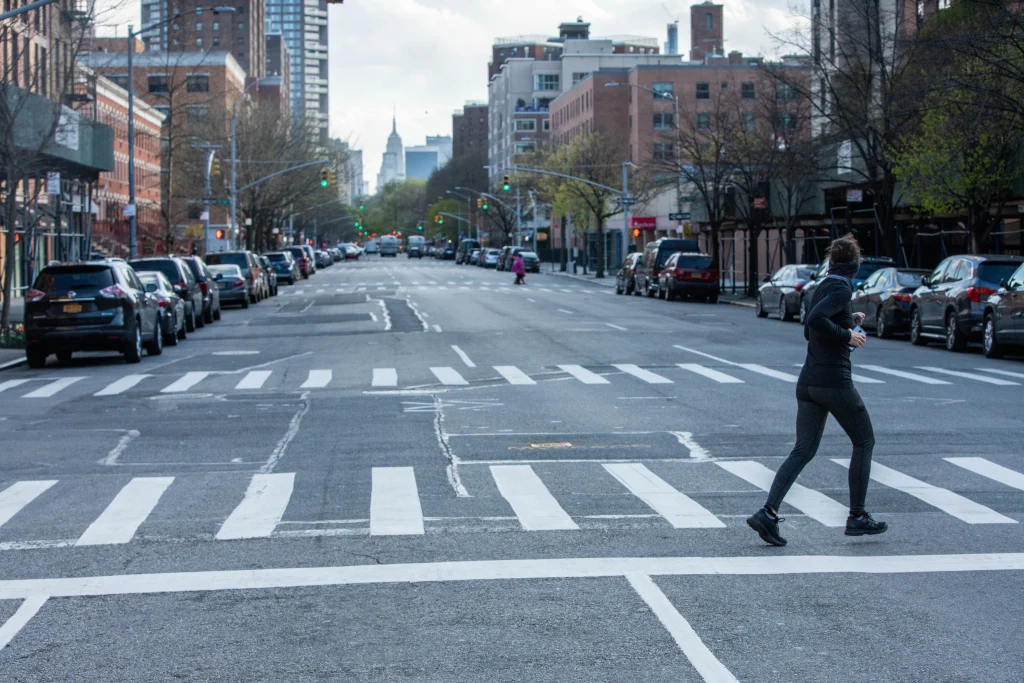
A man jogging on the streets of New York on April 16, 2020 – Photo by Anthony Quintano/Flickr
We must assume we are fighting a war against COVID-19—a conflict that will likely be prolonged, perhaps permanent. We must resolutely live our lives fully, refusing to put everything on hold “until the COVID-19 year is over.” We must live like our parents did during wartime: fighting bravely, laboring diligently, and loving fiercely with quiet strength.
I. The stockdale paradox and the illusion of hope
As the new school year begins, I observe a deep paradox: most government agencies, schools, teachers, and parents are not mentally prepared to treat online learning as a serious, long-term educational format. They see it as a temporary stopgap, hoping the pandemic will simply vanish. But when will COVID-19 truly end?
When the pandemic began, experts predicted an end by summer, or perhaps with the discovery of a vaccine. We have waited through summer, winter, spring, and into another summer. Vaccines are here, and many nations boast high coverage, yet COVID-19 persists, challenging humanity with new variants.
The leaders of highly vaccinated nations now acknowledge that humanity must live with the virus indefinitely. Yet, in Vietnam, the common phrase I still hear is, “Let’s wait until the COVID-19 year is over.”
We cannot wait for the virus to disappear to farm, seek medical help, educate our children, or serve the public.
This denial is captured by the Stockdale Paradox. Admiral James Stockdale, a U.S. POW for eight years, told author Jim Collins that the ones who died first were the most optimistic—the ones who truly believed they would be free by Christmas, and whose hearts were crushed by despair when the date passed. The Stockdale Paradox reminds us: You must never confuse the belief that you will ultimately prevail (which you must never lose) with the discipline to confront the brutal facts of your current reality.
I believe COVID-19 will eventually recede, but I accept the long-term reality. Survival requires immediate adaptation.
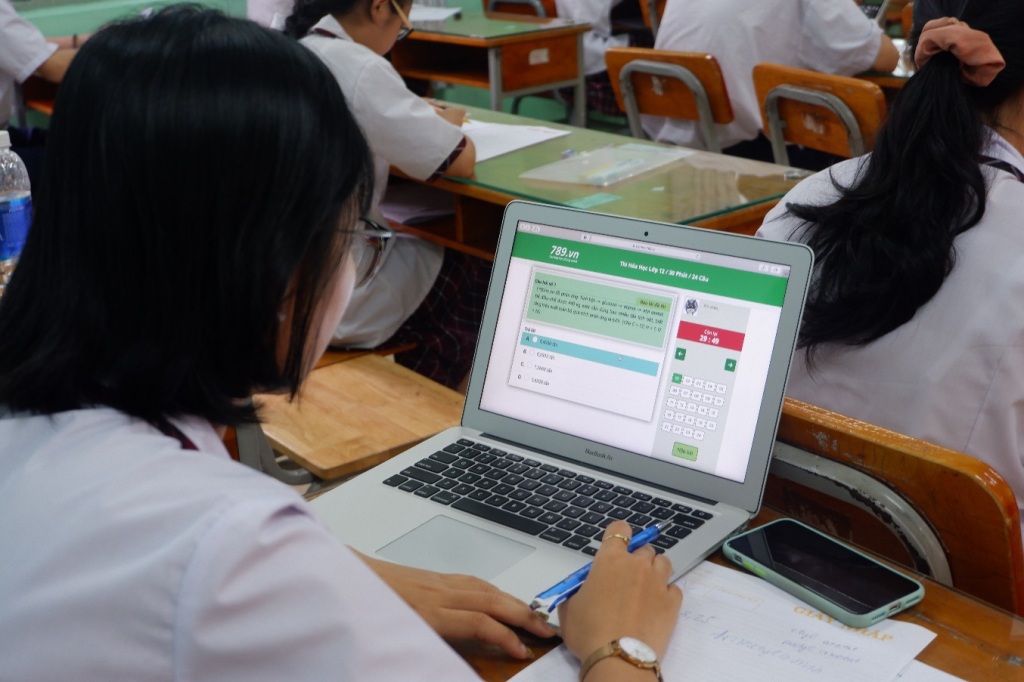
Students in Ho Chi Minh City take a mock online exam on the 789.vn platform.
II. The failure to commit to the new normal
Former Prime Minister Nguyễn Xuân Phúc long ago mandated that citizens must learn to live with the “New Normal.” Yet, many still live with an “on-demand” mindset, waiting for the return to the old ways. Education is a prime example of this failure to commit.
If the pandemic were to end in October, remote learning wouldn’t matter much. But what if it lasts another two or three years? Should we allow our children’s education to become “perfunctory” during that time? We must accept the cycle: sometimes we will be locked down, sometimes open, but we must master the “New Normal” regardless.
I have immense faith in children’s adaptability. Unlike adults, who have cognitive biases about the effectiveness of learning through machines, children adapt quickly. This crisis is a massive opportunity to cultivate digital literacy and self-learning skills. As Alvin Toffler said: “The illiterate of the 21st century will not be those who cannot read and write, but those who cannot learn, unlearn, and relearn.” Online learning is the essential skill of learning, unlearning, and relearning.
III. The mandate for equity and action
The government must be decisive. If we are slow to act, we will fall critically behind. I propose two final mandates:
- Do not let the equity gap become an excuse: The fact that some poor families cannot afford a computer (a device costing 60 to $80 USD) cannot be used as a reason to deny online education to millions of other children. This is like refusing to vaccinate millions because you cannot secure enough doses for everyone. We must find solutions for the poor (subsidies, donations) while simultaneously providing education for the majority.
- Commit to online learning permanently: Schools will only invest seriously in technology and curriculum development if the government officially accepts distance learning as a permanent, viable option. This signal is crucial to remove the fear of sunk costs and propel Vietnam toward a massive leap in educational technology.
IV. The Vietnamese wartime spirit
Our parents’ generation knew how to live and love during long conflicts. As the song Remembering Hanoi says:
“Remembering the time of war, when bombs fell The earth shook, tiles and bricks shattered, Yet you still rode your bicycle on the street, And I still sought new sounds.”
They understood the “New Normal” of wartime: they fought, worked, and created art simultaneously. We must adopt this spirit now. If there is still a way to survive, to maintain business, and to pursue life, we cannot accept “hibernating” until our final reserves are gone.
Let us consider this a continuous war with COVID-19. We must resolve to live our lives fully, just as our parents did.