
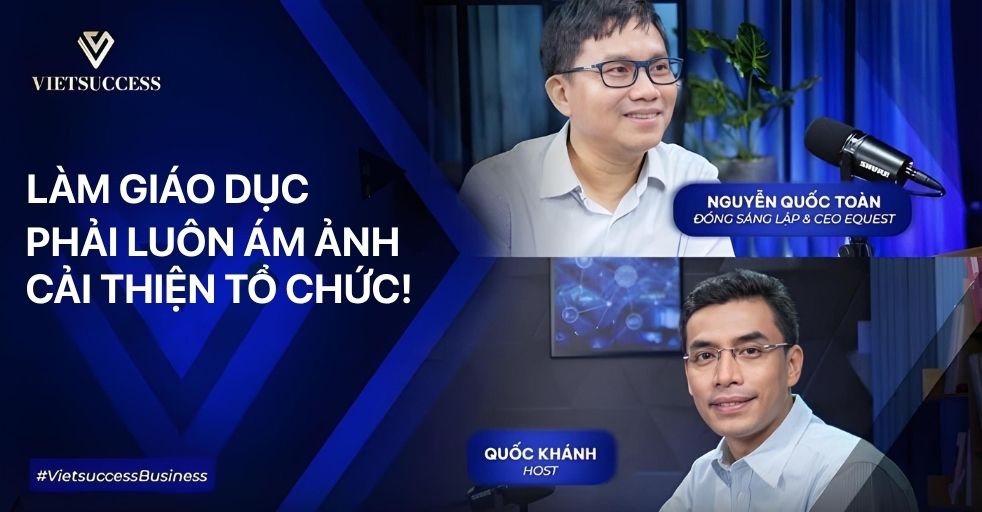
Vietnamese | Original: Làm giáo dục phải ám ảnh cải thiện tổ chức
Host Trần Quốc Khánh: I understand you are a finance and economics professional; your background is in finance and economics, and now you are working in education. I’m curious about the specific journey that brought you into the education sector.
Dr. Nguyễn Quốc Toàn: Actually, I have two careers: finance is my right hand, and education is my left hand. It’s not that I am new to education. We started considering the idea of education back when I was pursuing my Ph.D. in 2003. The company EQuest was founded immediately in 2003, and this August or September marks its 20th anniversary. Of course, many things have changed since then.
Initially, EQuest was a company focused on overseas study consulting. Gradually, it evolved into an investment company across various educational segments: college, university, K12, and educational technology. Education was previously my left-hand profession, but now it has become my right-hand profession; it is not a new field for me. Therefore, I already have 20 years of experience.
Host Trần Quốc Khánh: So, EQuest started as an overseas study consulting service…
Dr. Nguyễn Quốc Toàn: EQuest is an abbreviation for Education Quest, which signifies a long march (a “Quest”) in the pursuit of academic excellence, or it is the acronym for our slogan, “The Quest for Excellence.”
Initially, the founders cherished the ambition of transforming Vietnam’s education system. We deeply idolized the historical figure Phan Bội Châu, who led the Dong Du movement; at that time, we launched our “America Study” movement. To change the country, we felt we must learn the best practices and the most modern knowledge available globally. In my opinion, the best education at that time was in the U.S. Therefore, after securing a scholarship to pursue my Ph.D. in the U.S., I realized that the process was not overwhelmingly difficult if done meticulously and with sufficient preparation. Gradually, we created opportunities for our friends and colleagues to participate; this was the genesis of the company named EQuest.
Host Trần Quốc Khánh: It started as “America Study.” How did you transition to domestic education—the system of K12 schools and colleges/universities?
Dr. Nguyễn Quốc Toàn: After working in overseas study consulting for a while, we expanded into test preparation. Our initial investment in K12, college, and university segments was not a matter of strategic calculation but of sheer luck. Around 2012 or 2013, I had the opportunity to acquire an education group that included college, university, and test preparation centers in Ho Chi Minh City.
Subsequently, we recognized the opportunity in K12 education because K12 in Ho Chi Minh City was beginning to develop, and in Hanoi, it was developing well but lacked systematic investment. We began to shift our investment focus to include the K12 segment in our portfolio. This means we invested in college and university in 2013, and then added the K12 segment to our investment portfolio around 2016 and 2018.
However, since 2011, my co-founders and I had already begun thinking about EdTech. People are only talking about EdTech recently, but EQuest started thinking about EdTech more than a decade ago—12 years ago.
Host Trần Quốc Khánh: Specifically, what was EQuest doing in EdTech early on?
Dr. Nguyễn Quốc Toàn: Back then, we were focused on digital lesson plans (bài giảng số). Digital lessons are exactly what people are now talking about extensively, which is digitalization and digital transformation in education. We were doing that back then.
To be honest, teachers at that time did not even know what a digital lesson plan was. Concepts like converting lesson materials to digital format, automated grading, using artificial intelligence, and assessment were extremely novel, and the legal framework barely allowed for them to be recognized. The process was extremely difficult for us back then—it is still difficult now, but at that time, it truly felt like a pioneering, primal endeavor. We had to explain every minute detail, and our first inspiration came from a trip to India.
In the past, to seek educational excellence, one had to study in the U.S.; but to find solutions for optimizing education, one had to go to India. Because India is a highly populous country where resources are extremely limited, they have adopted highly disruptive thinking in education. How can you educate over a billion people with diverse levels of proficiency, economic backgrounds, cultures, and contexts in such a diverse democracy? They had to devise extremely disruptive solutions. So, my colleagues and I packed our bags and went to India, to Bangalore, to their Silicon Valley.
In 2011, we were already flying there to research and learn about their digital lesson model. A digital lesson plan is not complex. What does it mean? It means all lessons must be digitalized and must be engaging and interesting so that students learn joyfully and naturally. A digital lesson is not a 30-to-40-minute long video; sometimes, it’s just an animation, a very short lesson of three or four minutes, or even less, but it must be immediately followed by a test, and it must be interactive and engaging.
We thought about this back then, asking, “Why must we do this?” Because if you want to change education, you need to change two things: teacher quality, and content/curriculum. However, changing teaching quality is not easy; improving teacher training takes several generations. But changing the curriculum is something that can be done immediately with the support of technology. We started with the second element. After that, we began adding more investments. When we secured institutional investors like the TAEL Fund, they provided us capital to expand into Hanoi and Saigon, investing in K12 schools. This was a continuous sequence—it involved strategic calculation but also a measure of luck.
At that time, we were pioneers in investing in private K12 education through the model of consolidation. Our investment involved buying and acquiring schools, which we called restructuring, supporting existing schools to improve. We started in Hanoi, and while we lagged behind other competitors in Saigon, we can consider ourselves the first in Hanoi to execute the consolidation of schools.
Host Trần Quốc Khánh: In 2011, the concept of a digital lesson plan was still new, not yet popular, as you shared. And you mentioned that to change Vietnam’s education, you started by changing the curriculum—digital lessons. How did you adapt and apply the knowledge learned in India back in Vietnam? Was the process difficult?
Dr. Nguyễn Quốc Toàn: The process was extremely difficult because India was far ahead of us; even now, India is far ahead of us, far ahead of the world, in this regard—they had already completed everything. Initially, my colleagues and I were eager to import their model wholesale, but upon returning to Vietnam, we criticized it: the Indian accent wasn’t “standard,” and the digital content did not align with Vietnamese culture. Subsequently, we had to adapt and localize it for Vietnam. We organized seminars and presentations. I, along with my colleagues, even stood handing out flyers and hosted guests at the Caravelle Hotel. Organizing the initial seminars was challenging, but gradually, as people witnessed the positive impact, they became highly supportive. In fact, we received substantial support from various departments and agencies because they recognized our serious commitment to digital transformation, and no other company was willing to invest such a high volume of human and financial resources into digital lesson plans.
Host Trần Quốc Khánh: Why did you need digital lessons at that time? How did they supplement traditional teachers?
Dr. Nguyễn Quốc Toàn: To put it simply: we taught Math and Science in English using those digital lessons. If you try to make students proficient in English through traditional methods, they won’t remember it. But if you want them to remember long-term, you must make them think in English. Thinking in English is the crucial keyword. What is the easiest content to think in English? Math and Science concepts. Scientific concepts are not abstract or complicated. Scientific thinking means concepts as simple as “1+1=2” or water boiling at 100 degrees are “hot.”
When students think using these concepts, they become proficient in English, especially when starting with something very simple. Essentially, we were teaching an international curriculum at an extremely low cost and simplifying it significantly. Students at international schools speak English very well because they are taught in English, not because they attend daily English lessons focused on “hello,” “how are you,” “what’s your name.” Students will not remember those phrases. But if you teach them immediately using an English curriculum, they will remember quickly. This was a shift in our approach.
Instead of teaching English, we teach students to think in English—teaching concepts, categories, calculations, and simple scientific principles in English. When they think this way, they remember long-term. For example, the term for a writing instrument is no longer bút; it is “pen.” Water is no longer nước; it is “water.” Don’t force them to translate nước to “water”; let them understand nước as nước and “water” as “water”—the two are distinct. That is EQuest’s approach.
Host Trần Quốc Khánh: Specifically, were these digital lessons simply pre-made videos?
Dr. Nguyễn Quốc Toàn: Digital lessons are instructional materials that are highly animated and digitized, featuring enhanced graphics, short lessons, or very brief video segments. For example, if a student learns about the historical figure Thánh Gióng, they would watch a very short film about him, lasting only two or three minutes, and then complete exercises based on the content. If they learn about the heart’s structure, the digital lesson would illustrate the heart in 3D. This makes learning very fast, and since it’s in English, students retain much more. Instead of passive learning, the digital lesson is highly interactive; students can click on the heart, and the ventricles and atria open, allowing them to instantly grasp both the scientific concept and the English terminology.
Host Trần Quốc Khánh: How did digital lessons impact teachers?
Dr. Nguyễn Quốc Toàn: The great benefit of digital lessons is that they are highly structured: how to start, how to conclude, what the body content includes, and what the exercises are. When teachers use digital lessons, they are no longer just instructors; they become coordinators. That is the essence of the teacher’s role in the 4.0 era. Instead of teaching the content, they coordinate the experience.
When a digital lesson begins, the teacher’s role is to stimulate student participation so that students can answer questions after engaging with the content, rather than the teacher having to lecture from the beginning. When discussing the heart, showing students a video about the heart is certainly more effective than the teacher describing it verbally. Frequent interaction makes students’ thinking more logical and their approach more systematic. Furthermore, teachers in remote areas who may not have standard English training will also improve their pronunciation.
Digital lessons have a dual impact: they support student learning while simultaneously helping teachers refine their logical thinking, adopt a more systematic approach, and improve their English proficiency. They also significantly reduce the time spent on preparing lesson plans, which increases scalability quickly because teachers no longer have to prepare different lesson plans daily.
For instance, we currently teach over 100,000 students using this method successfully. Our impact assessment confirms that learning English through digital lessons creates a very noticeable difference in student outcomes.
Host Trần Quốc Khánh: Beyond the content and the accent, what did you learn from India? Specifically, how did they produce those digital lessons?
Dr. Nguyễn Quốc Toàn: We learned their method for creating digital lessons, how they structured the content, and how they designed tests. They had mastered all these aspects years ago. Everything we are discussing and doing now, India accomplished 10 or 12 years ago, and they did it much better than us.
Host Trần Quốc Khánh: After 12 years, how has the application of digital lessons evolved within the EQuest school system?
Dr. Nguyễn Quốc Toàn: Firstly, we not only use them in EQuest schools but also license them extensively to public schools. This significantly reduces the cost for students learning English. Instead of paying $50−$100 for English lessons, they pay only $10−$20, equivalent to about 200,000−600,000 VND per month—it is vastly cheaper.
Secondly, our lessons are assessed and accredited. EQuest is currently the only private education organization in Vietnam accredited by Cognia, the largest K12 and EdTech accreditation organization globally. This positively impacts teachers, who learn a new approach, and students, who find the content more engaging.
Host Trần Quốc Khánh: So, it provides additional tools…
Dr. Nguyễn Quốc Toàn: Everything we are now discussing as digital transformation, we have been doing for a decade. This means every class starts with a pre-assessed lesson plan. Of course, our lessons have evolved significantly compared to the rudimentary, primitive initial versions. Our current digital lesson system is much more engaging and localized than the Indian models we first encountered.
Host Trần Quốc Khánh: Besides the content bought from India initially, are you creating your own now? What is the demand for digital lessons in Vietnam?
Dr. Nguyễn Quốc Toàn: We create almost all our content ourselves, and the demand for digital lessons is very high; we simply cannot meet all the demand. However, the role of the teacher remains indispensable. A teacher is essential, but their role is no longer just to teach; it is to coordinate and inspire. This aligns exactly with the current discussion around artificial intelligence and the role of the teacher. Teachers must effectively utilize these digital resources. Demand is high, and our solutions are highly effective, high-quality, and far more evolved than in the past.
We have invested over ten million dollars in developing digital lessons, which now include embedded assessment and gamification features. Compared to what we learned during our “Journey to the West” (Tây trúc lấy kinh), our system is vastly different and much more localized and engaging.
Host Trần Quốc Khánh: With all these changes and tools, how do you see the role of the teacher in this new era? What is their core responsibility?
Dr. Nguyễn Quốc Toàn: First, we must recognize that the teacher in this era is liberated. Just as the weaving machine liberated workers from manual weaving, and the automobile freed people from riding horses, digital lessons and digital transformation liberate teachers.
Liberated from what? From routine, daily tasks. They no longer have to mechanically prepare lesson plans or manually grade papers. Their job is not to compile and synthesize knowledge; AI and digital lessons do that for them. Their role is to become more human, to make students love learning, and to coordinate the classroom experience so that students remain engaged and passionate about the lesson, today and tomorrow.
The teacher’s role is becoming less about delivering knowledge and more about stimulating, motivating, and supporting. We have pursued this model for a long time, and now it is entering a boom period; we are glad we anticipated this trend.
Host Trần Quốc Khánh: So, it fundamentally changes the function of the teacher in this era—they are no longer knowledge transmitters but coordinators…
Dr. Nguyễn Quốc Toàn: They are no longer just knowledge transmitters. A teacher still needs to transmit knowledge, but they must do so strategically. Rote learning is no longer engaging for students; it can never be as compelling as watching a film. Showing a film about Thánh Gióng flying into the sky is always better than verbally describing it. Watching a 3D, interactive graphic of DNA or the structure of the heart is definitely better than a verbal description. But the teacher’s new challenge is to make the student want to learn about DNA or the heart—that is the difficult part. This does not diminish the teacher’s role; it elevates their required skills and adds new competencies.
Host Trần Quốc Khánh: What barriers do you see to applying digital lessons in Vietnam’s public education system, besides cost?
Dr. Nguyễn Quốc Toàn: Actually, the cost of digital content is not the biggest barrier; the biggest cost is the investment in basic infrastructure. Now that we are talking about digital transformation, there are two primary issues:
The first is the legal issue. Vietnam does not yet formally recognize automated online testing. Online exams, especially for midterms and finals, are not recognized unless there is strict supervision in the room. This is despite the fact that global universities like Harvard, MIT, and Columbia accept tests like Duolingo, which students take at home. Digital transformation’s first hurdle is the legal barrier: recognition of online instruction and test results. Public schools struggle immensely with this because compliance is mandatory. To change this requires changes to the Education Law, potentially requiring a National Assembly decision on unsupervised online testing. Without a supervisor, the cost of integrity assurance (cameras, facial recognition, anti-cheating measures) is very high.
The second barrier is the investment in basic infrastructure. Students must have computers or smartphones. Not all students, particularly in remote areas, have access to computers. Even in large cities like Hanoi and Ho Chi Minh City, many students in outer districts lack access. These are major hurdles. The state could subsidize or build low-cost computer labs; these are actions the government must prioritize.
Host Trần Quốc Khánh: If there are legal and infrastructural barriers to online testing, how can public schools use digital lessons to assist teachers, as you mentioned?
Dr. Nguyễn Quốc Toàn: It helps a great deal, and public schools are using it because it makes learning more engaging for students. Only the assessment and testing part is difficult—it is not formally recognized. But other functions are utilized, saving significant preparation time. Now, almost all curricula are digitized and animated to make learning more interesting. This “animation movement” in education is focused on creating mechanisms that make learning more fun, effective, and personalized for students.
Host Trần Quốc Khánh: When you invest in and merge schools, what do you see as the biggest problem regarding the quality of high school education in Vietnam?
Dr. Nguyễn Quốc Toàn: In my assessment, Vietnam’s high school education is relatively good; higher education is the major problem. We will discuss higher education later.
High school education in major cities is not poor. Vietnamese students who go abroad often perform well in advanced international programs, and our national and international test ratings are quite high. So, what are the problems?
The first problem is physical infrastructure in public schools. A class size of 50–60 students means students cannot engage or access resources effectively. This is a significant problem, particularly in less affluent cities or residential areas.
The second problem is the continuous professional development of teachers. I see that public school teachers genuinely want to improve and upgrade their skills, but creating those opportunities is time-consuming and costly, involving many seminars and training sessions. We need a way to simplify these procedures.
Thirdly, public school teachers have low income and need mechanisms to increase their earnings. When teachers have slightly higher incomes, they are more dedicated, perform better, and are more productive. We must create mechanisms to allow for higher income in the public sector. Currently, salaries for public school teachers, especially those teaching non-core subjects, are very low.
Host Trần Quốc Khánh: Teacher salaries are a perennial topic in the media. From the perspective of an education investor, how do you see the solution to teacher pay?
Dr. Nguyễn Quốc Toàn: I’ve written extensively about this. First, open up the sector more to private investment. Private investment currently accounts for less than 5% of the total investment in education. If the private sector were allowed and supported to grow to 20% to 30%, the burden on the public sector would be significantly alleviated, giving the state the capacity to increase public salaries.
Second, we must create mechanisms for public-private partnerships (PPP). Vietnam is a dynamic country that allows for such arrangements, and we must be more open about them. We must stop viewing private involvement in education negatively because when it is allowed, teachers gain opportunities to supplement their income.
For instance, the debate about banning private tutoring is wrong. Teachers should not teach their own students privately, but they should have the right to provide private tutoring generally. Why is it wrong for a teacher to earn extra income when a doctor is allowed to open a private clinic?
To improve the situation, we must first correctly recognize these realities. We must stop demonizing teachers in the media for tutoring. I believe most teachers tutor to improve student knowledge, and they have the right to earn money honestly.
Therefore, the solution is: (1) Strongly promote the private sector to reduce pressure on the public sector. (2) Promote genuine public-private cooperation to create mutually beneficial solutions. (3) Increase teacher income and stop making private tutoring a social stigma.
Host Trần Quốc Khánh: What are the constraints on promoting the private sector?
Dr. Nguyễn Quốc Toàn: It’s not a restriction, but rather, the government’s support is often merely moral support. When you look closely, implementation is very difficult. For example, in residential planning, there is often a situation where “some have too much, others have nothing.” We are capable of investing in 20 to 30 schools simultaneously nationwide, but we cannot find the land. The available land has often been reserved by speculators 10 to 15 years ago. When we inquire, the price is exorbitant, making investment financially unviable.
This means the mechanisms exist, but the sanctions or regulations are complex and cumbersome. The government supports private education, but the layers of sub-licenses and regulations make it impossible for the private sector to act effectively.
Host Trần Quốc Khánh: What is the biggest hurdle for public-private cooperation?
Dr. Nguyễn Quốc Toàn: It’s not inherently difficult, and Vietnam has provided a lot of support. But we need to remove the psychological barrier. For example, if there are digital transformation solutions that public schools cannot implement themselves, the government should allow private participation, and parents should also contribute. Parents are willing to pay for digital solutions, but if the state does not facilitate cooperation with private entities, it is very difficult.
We have EdTech platforms like MegaSchool and MegaTest that we want to bring to public schools. But without a financial mechanism, we cannot provide them for free indefinitely; there must be a business model. We only want to charge a very small fee per student, but without a clear mechanism, the public school says, “This is a public school, you cannot do business here.” We need enthusiastic, open support, not reluctant, secretive acceptance.
Most provinces support this, but it needs to be viewed as a serious national strategy. For instance, in Mù Cang Chải, we taught Math and Science in English to 2,000 to 3,000 students at once. The local government was supportive, but the mechanism for operation was unclear. Even when we teach for free, there should be a mechanism to support us.
In summary, PPP requires (1) clear mechanisms and (2) genuine, visible support.
Host Trần Quốc Khánh: You said high school education is generally okay, but higher education is the main problem. What are the biggest issues in higher education?
Dr. Nguyễn Quốc Toàn: (1) The curriculum is slow to update and innovate. (2) Subjects are obsolete compared to global standards. (3) There are significant restrictions on teaching new subjects. (4) There is an excess of restrictive criteria and regulations.
For example, if a student wants to study a course by a Nobel laureate, the current laws may not allow the certificate to be accredited. If a student wants to learn about media from you in Saigon, but the student is in Hanoi, current law only allows a maximum of 30% of total credits to be earned through distance learning. Why not 50%? Why not 100%? If a student wants to study under a world-class professor, that professor must physically be in Vietnam to teach the class for the credit to count. While the world talks about digital universities and open education, we are restricted by outdated regulations.
Host Trần Quốc Khánh: Why is the curriculum so difficult to change?
Dr. Nguyễn Quốc Toàn: Because the quality of the faculty itself is not truly excellent. We have a tendency toward “copycat teaching” (cơm chấm cơm)—graduates teach the next generation without sufficient industry experience. This trend cannot support distance learning while the rest of the world is rapidly accelerating. Global training courses are often difficult to accredit for local use.
Higher education needs extremely rapid change. The global trend is toward mini-credits and micro-certificates. Instead of a large, fixed university degree, students should accumulate small, modular certificates that add up to a full degree. This fixed structure is obsolete. We are making progress, but we need more openness and less control to accelerate change.