
Analyzing Ho Chi Minh’s leadership style through the lens of modern management theory reveals profound insights, deepening my respect for the historical figure and providing invaluable lessons for today’s executives.
The visionary obsession (Level 5 ambition)
A defining quality of any great leader is an unshakeable, clear, and contagious vision. Ho Chi Minh consistently articulated his purpose with extreme clarity and singular obsession.
One of his most powerful declarations was: “No matter the sacrifice, even if we must burn down the entire Trường Sơn mountain range, we must resolutely regain independence.”
This statement reflects an iron will and an absolute commitment to a unified Vietnam. It exemplifies the highest level of leadership commitment to an organizational vision, demanding total conviction from followers.
Management by OKR and focused execution
A leader cannot afford distraction; they must identify the critical center point to ensure all work flows smoothly.
The most striking example of Ho Chi Minh’s focused execution occurred immediately after Vietnam gained independence in 1945. The nation’s first priority was not economic development or military strength. In the inaugural government session on September 3, 1945, President Ho Chi Minh proposed a campaign to “Eliminate Illiteracy,” declaring: “An ignorant people is a weak people.”
This declaration struck at the pride of the entire nation, generating a massive wave of learning. Tens of thousands volunteered to teach without pay. A nascent government, lacking resources, virtually eradicated illiteracy in North Vietnam within two years—a miraculous feat. Ho Chi Minh demonstrated the strategic value of identifying and solving a single, critical bottleneck to unlock massive societal change.
Furthermore, his national objectives perfectly align with modern management frameworks like OKRs (Objectives by Key Results):
- Objective: Build a prosperous and powerful Vietnam.
- Key Results (KRs):
- The country is completely independent.
- The people are completely free.
- All citizens have food, clothing, and education.
His objectives were simple, uncluttered, easy to communicate, and highly measurable.
Talent management: Meritocracy and succession
Modern talent management is about merit-based promotion, fair compensation, and effective succession planning. Ho Chi Minh applied these principles with innate clarity.
The promotion policy
When a foreign reporter once questioned the large number of generals promoted at a single ceremony, Ho Chi Minh’s response was a masterclass in clear, meritocratic policy: “Defeat a Colonel, become a Colonel; defeat a Major General, become a Major General; defeat a Lieutenant General, become a Lieutenant General; defeat a General, become a General.”
This reply is direct, transparent, and serves as an ideal merit-based promotion policy. It links rank directly to demonstrated talent and measurable success on the battlefield, equating achievement with status.
Successor planning
The true test of talent management is succession planning. A correct strategy prioritizes the person best equipped to realize the organization’s vision, regardless of personal preference. Ho Chi Minh selected Lê Duẩn to execute the vision of national reunification.
In 1957, Lê Duẩn, who had operated primarily in the South and had met Ho Chi Minh only once in a decade, became the First Secretary, surprising many who expected a closer associate like Võ Nguyên Giáp or Phạm Văn Đồng. However, no one understood the revolution in the South better than Lê Duẩn. Ho Chi Minh’s most admirable act was, even as he was arguably sidelined in his final years, his refusal to act as an “emperor emeritus,” instead respecting Lê Duẩn’s supreme authority to carry out the mission of liberating the South.
Communication mastery: The simple, emotional message
The ability to mobilize the masses is essential for a leader. Ho Chi Minh’s prose and oration possessed immense power, moving millions. His writing was always simple, direct, uncluttered, and deeply authentic, ensuring universal comprehension.
His masterpiece, the Declaration of Independence, exemplifies this:
- He began by quoting the U.S. Declaration of Independence, establishing a clear philosophical foundation for Vietnam’s actions.
- He used repetitive, simple, and emotionally charged language to amplify the sentiment: “A people who have courageously opposed French enslavement for more than eighty years, a people who have resolutely sided with the Allies against the Fascists for the past few years, that people must be free! That people must be independent!”
Though 90% of the population was illiterate, everyone could grasp his message—a testament to his unparalleled communication genius.
Humility: The level 5 leader
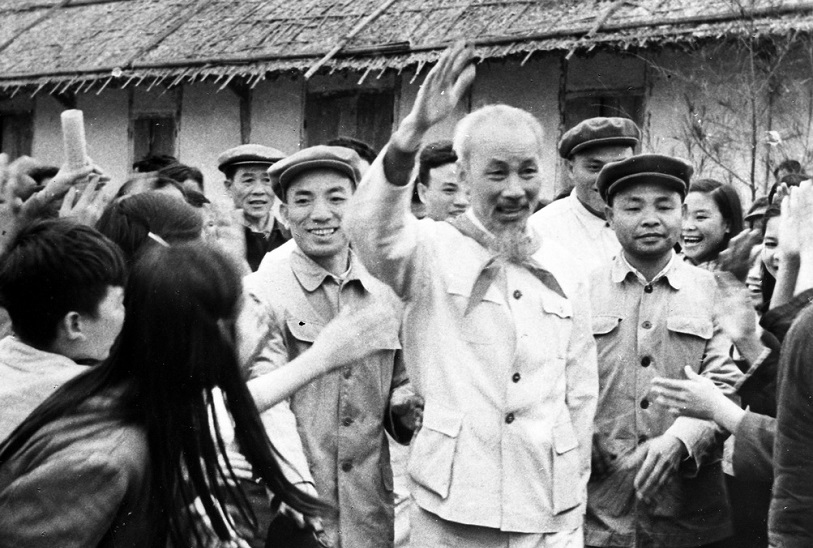
Ho Chi Minh’s simplicity and humility require little debate. Despite constant media sanctification, he avoided a personality cult. He smoked, dressed simply, strictly avoided elaborate ceremonies, and most critically, he never governed autocratically to accumulate wealth or luxury, unlike many other totalitarian leaders.
He never demanded a mausoleum for himself and consistently shunned public fanfare. One will struggle to find a picture of Ho Chi Minh being greeted with a banner saying, “Warmly welcome President Ho Chi Minh to visit and work at…”—a common sight for many modern leaders.
According to Jim Collins’s Level 5 Leadership theory (From Good to Great), Ho Chi Minh’s style is the quintessential example of Level 5: a rare combination of extreme will/fierce ambition and profound personal humility. His ambition was vast, not for personal gain, but always for the organization and the collective purpose.
Leaders, let us learn from the mandate set by Ho Chi Minh.