
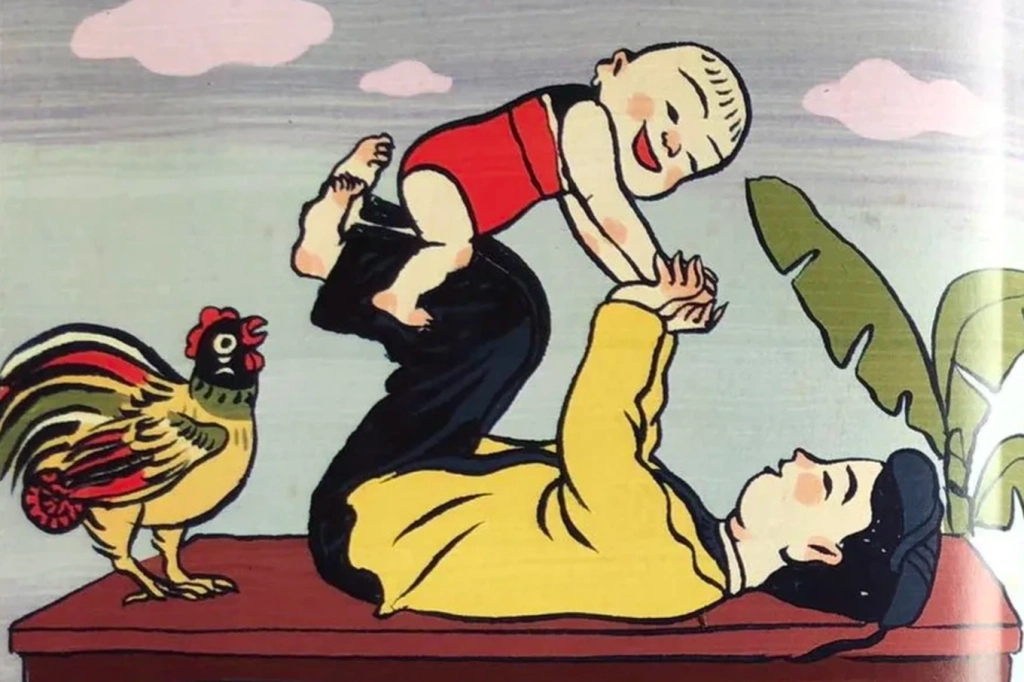
Illustration of the folk rhyme “Giã gạo thổi cơm” (Photo of the book page).
I. The inescapable truth: Lying is human nature
Who among us has never told a lie?
Imagine this scenario: Your family is desperately poor, with just one measure of rice left to feed your very young child. A neighbor, equally impoverished, comes to borrow rice. What do you say?
Likely, 99% of people would say they have none, needing to conserve the last grains for their child. You lie to spare the neighbor’s feelings. Those who lived through the subsidy era, when an unadulterated bowl of rice was a luxury, understand this primal calculation.
This universal instinct is why the recent public outcry over a Vietnamese nursery rhyme is so ill-informed. The rhyme, which advises the listener to hide their rice and lie to a borrower, was deemed “anti-educational” for teaching children to be dishonest.
We must stop stigmatizing the act of lying. It is an innate human instinct. Studies suggest children begin lying as early as six months old, faking tears to gain attention. By age two, lies become more sophisticated, used to self-protect from punishment.
Adults are far worse. When the show Lie to Me was launched, a survey revealed that the average man lies to his partner, colleagues, or friends six times per week. Women lie about half as often. Yet, only 12% of adults admit they lie frequently. Denial is part of the lie. We cannot ban this instinct, only understand it.

The folk rhyme “Giã gạo thổi cơm” appears in the book Nựng nựng nà nà, part of the Children’s Folk Rhymes series published by Kim Đồng Publishing House in 2022. This work has become the source of online controversy (Photo of the book page).
II. The necessary lie: A defense of survival and statehood
People lie for complex reasons, and the act is not inherently good or evil; it depends entirely on the context and motive.
Consider Franklin D. Roosevelt, the only U.S. President to serve four terms, who navigated the Great Depression and World War II. For twelve years, he and the U.S. press executed a “great lie”: concealing his paralysis. Americans were only shown photos of him seated or standing, supported, projecting an image of unbreakable strength crucial for leading the nation through its darkest years. Only after his death was the truth revealed. The American public did not condemn the lie; they understood the motive of compassionate necessity behind it.
The purpose of education is not to prohibit lying, but to teach a child to distinguish between a harmless untruth and a destructive one, and to understand the impact of their deception.
Lies often emerge from:
- Self-defense: Lying to protect oneself from unnecessary conflict or harm.
- Diplomacy: Offering false praise for a bad haircut to safeguard a relationship (a form of social intelligence).
- Compassion: Hiding news of a serious accident from a parent with a heart condition.
The most critical skill parents and educators can impart is the balance between absolute honesty and diplomatic skill—the wisdom to know when one must be prioritized over the other.

Illustration of the fairy tale “Tấm Cám” by Trẻ Publishing House (Screenshot).
III. The angelic myth vs. the logic of deterrence
This dilemma is starkly illustrated by the second cultural controversy: the push to sanitize the Vietnamese fairy tale of Tam and Cam (Cinderella). The original, gruesome ending—where Tam, now the Empress, kills her stepsister Cam, makes her body into preserved sauce, and sends it to her wicked stepmother—is often censored for being “anti-educational.”
The sanitized ending replaces this with a lightning strike, killing the evil pair. But the original, “barbaric” ending is the most logical and pedagogically robust one under the context of:
- Legal Justification: Tam had been murdered and harmed multiple times by Cam and the stepmother. As Empress, her execution of Cam was legally sound; harming a royal was a capital offense.
- The Failure of Forgiveness: Tam had been merciful four times and paid dearly for it each time. She learned that continuous malice cannot be stopped by continuous mercy.
The folklore delivered a profound lesson in deterrence. If your child is constantly victimized, do you want them to remain a weeping angel, waiting for a fairy godmother to ask, “Why do you cry?” Or do you want them to learn the final, necessary lesson of self-defense and resistance?
This act of final, ruthless revenge is perfectly explained by Game Theory, specifically the Grim Strategy. In the Grim Strategy, a player begins by cooperating (being kind, like Tam) but switches to a maximum, unrelenting retaliation the moment the opponent defects (Cam’s repeated murder attempts).
The folk tale’s brutal ending serves as a warning: The cycle of evil must be met with a response so overwhelming that the wicked are utterly terrified of repeating their actions. Tam’s revenge was meant to permanently deter evil—a lesson in survival that the world has endless room for.
We want our children to be angels, but life has no room for angels. Suppressing complex narratives does not protect children; it disarms them, robbing them of the capacity for critical thought, contextual judgment, and necessary self-defense.