
The question is common and agonizing for parents in Vietnam: Should I move my child from a thriving, advanced private school to a prestigious public specialized high school (trường chuyên) they recently tested into?
My answer, as an economist, a former specialized school student, and a parent of college-aged children, is delivered with utmost sincerity: If you have the financial means—even if it requires some sacrifice—keep your child in their current high-quality private school. Only move them if financial constraints are absolute.
Here are the specific reasons why transferring schools at this critical juncture is a high-risk gamble.
I. The high-risk gamble: The “If It ain’t broke” principle
The fact that your child is successful enough to pass the highly competitive entrance exam for a top specialized school is proof that their current private environment is working. The British adage holds: “If it ain’t broke, don’t fix it.”
Transferring a successful child now is a high-stakes gamble. You are trading a proven, harmonious ecosystem for an entirely new environment where the academic pressure is guaranteed to be higher, and the social and emotional risks are unknown. You might improve academic scores marginally, but you risk disrupting a critical developmental balance.
II. The psychological cost of hyper-competition
The “Big-Fish-Little-Pond Effect” (BFLPE) suggests that highly able students perform better and have higher self-esteem when placed in environments with average peers. Research by Herbert Marsh confirms that social comparison in highly competitive settings can severely reduce self-concept.
Specialized schools, filled with “super-sharks,” pose a significant psychological risk. A student who was once at the top of a strong class may suddenly find themselves ranked at the bottom of a class full of city-wide prodigies.
- Impact: Intrinsic motivation gives way to external pressure and anxiety. This pressure can stifle the very creativity, passion, and joy of learning that led to their initial success.
- The Outcome: Studies estimate that only the top 30% of students in such hyper-competitive cohorts truly thrive; the bottom 30% often feel intellectually inadequate, placing an unnecessary burden on their mental health.
Unless your child is a documented academic genius and immune to peer pressure, there is no need to place them in an environment where they will constantly feel stressed and ranked against the best of the best.
III. The shifting metrics of success
Many parents believe specialized schools guarantee easier entry into top universities. This perception is outdated. Leading universities in the U.S., Europe, and even Vietnam now look beyond GPA. They seek holistic development: involvement in extracurriculars, research, volunteering, and sports hold significant, often equal, weight to academic scores.
- Flexibility: Private schools generally offer more flexible schedules, giving students the crucial time needed to invest in non-academic activities like competitive sports (a proven predictor of success in higher education).
- Resources: It is a myth that private schools cannot compete academically. Private systems like EQuest consistently place students in national and international competitions and can afford to hire outstanding faculty and integrate advanced technology faster than the public sector.
IV. The hidden health factor: Height and physicality
This reason is observational, but vitally important: I believe that, on average, students in advanced private schools are taller and physically healthier than their counterparts in specialized public schools.
Height and physical health are assets linked to confidence and career opportunity. Why the difference?
- Nutrition: Advanced private schools offer higher quality meal plans (often costing $60–$100 VND per day), unconstrained by the lower, fixed budgets often found in public schools (around $35,000–$45,000 VND per day).
- Sleep: Adequate sleep is paramount for growth hormone (GH) release in adolescents (requiring 8–10 hours). Specialized public schools often require long commutes (45 minutes to an hour each way) and exceptionally early start times. Coupled with high study pressure, students routinely suffer chronic sleep deprivation. Private schools are often chosen for their proximity or offer later start times, giving students a vital edge in physical development.
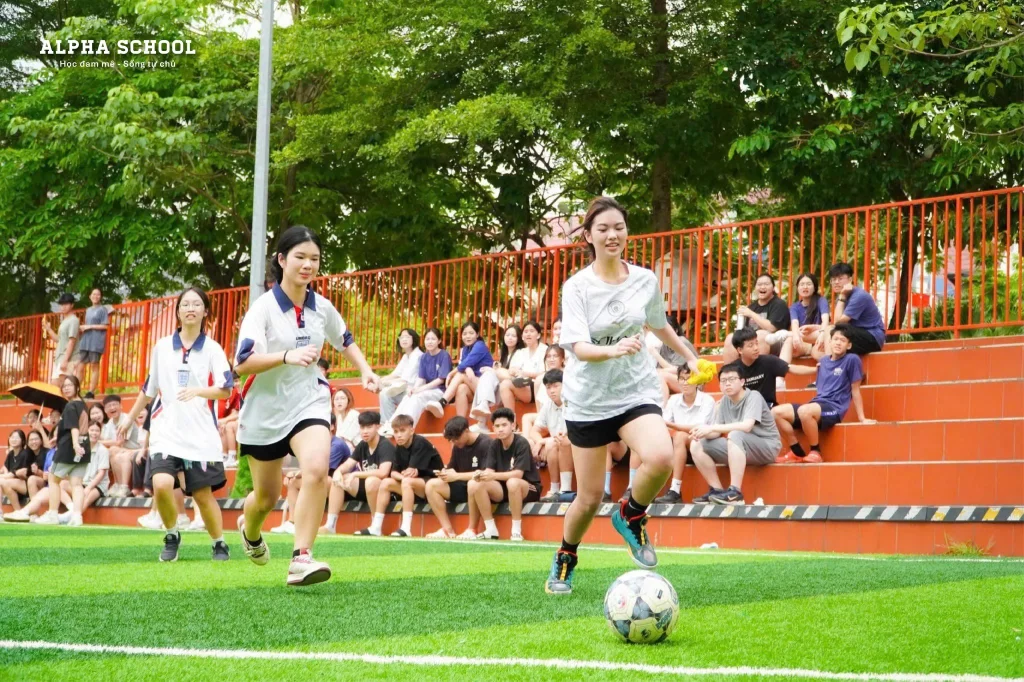
- Sports and Facilities: Lower class sizes and greater financial resources mean private schools offer better sports facilities, fields, and clubs, with more time allocated for physical activity.
Education must not only look at the score card but also the growth chart.
V. Choosing the long run
The decision to transfer a child often stems from a parent’s natural desire for “recognition” or “keeping up with the neighbors.” But this parental ego comes at a cost to the child: chronic stress, sleep deprivation, less physical activity, and stifled personal interests.
If you have the financial means and your child is thriving, happy, and developing holistically in a quality private school, transferring them to a specialized school is rarely an upgrade—it risks shattering a valuable equilibrium.
- For Confidence: Let your child be the “big fish in a pond of moderate size.”
- For Health: Ensure your child has enough sleep, good nutrition, and physical activity.
- For Future Success: Do not let your child be submerged in a pure score race.
Every child is on their own unique course. Choosing a school is choosing whether they run fast, or whether they run far. Look to the long game.