
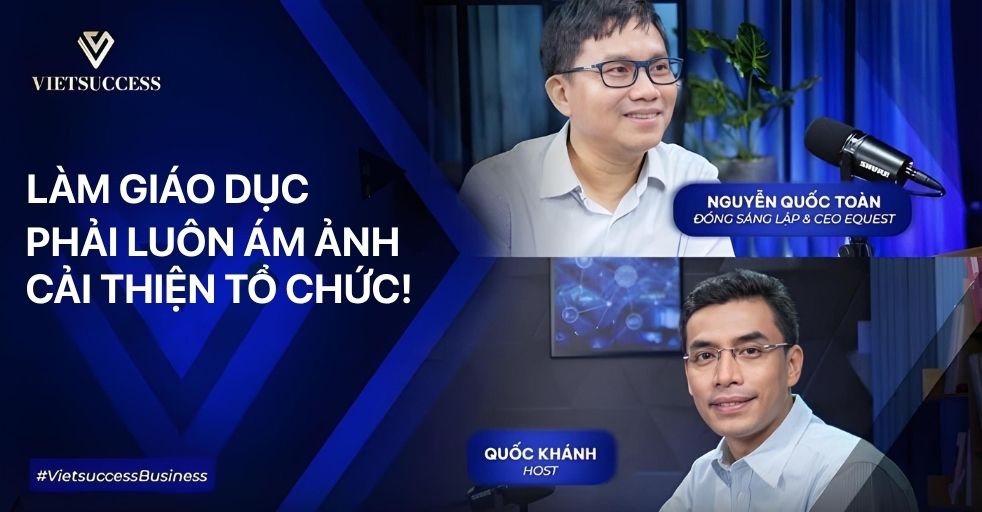
Annotation: Content rewritten from an episode of the Business Insights content series—an education talkshow hosted by Mr. Tran Quoc Khanh, Founder and CEO of Vietsuccess. In this talkshow, Dr. Nguyen Quoc Toan and Mr. Tran Quoc Khanh discussed various topics such as:
- Doing Edtech and digital transformation? Since when has EQuest been engaging in digital transformation? – EQuest’s story of going “to gather scriptures” in India (regarding digital transformation) back in 2011.
- What is the role of a teacher? What is the paramount purpose of digital transformation, from one’s perspective?
- What are the views on the “achievement disease”? Why is being fond of “achievements” still a good thing? Why should we not criticize the “achievement disease”?
- How do private actors invest in education? Especially under the perspective of economics/finance professionals.
- What must be done to attract talent? How should leaders conduct themselves? Why will few talented individuals want to work with someone who behaves like a “chairman”? What must be done to manage a “galaxy—full of talents”?
- How to raise capital in this era of “clever people, scarce goods”?
- What is EQuest’s educational philosophy?
- What do students need to learn? And what do teachers need to be trained in?
- And several other things….
Host Tran Quoc Khanh: It is known that you are a finance and economics person, with a background in Finance and economics, and now you are working in education. I wonder what fate or journey brought you to the education sector?
Actually, I have two professions: my primary job is in finance, and my side job is in education; it’s not that I just entered education. Since I was working on my doctorate in 2003, we already began thinking about the story of doing education. The EQuest company was established right in 2003, and around August–September this year, it marks exactly 20 years since its founding. Of course, after that, there were many changes.
Initially, EQuest was a study-abroad consulting company. Later, it gradually expanded into an investment company in educational sectors: colleges, universities, K-12 schools, and educational technology. Previously, it was a side job, but now it has become the primary job rather than a new profession. Therefore, there are already 20 years of experience.
Host Tran Quoc Khanh: Initially, you set up EQuest like study-abroad consulting…
EQuest is the abbreviation for Education Quest, which means a long march in search of educational efforts, or an abbreviation for our slogan “The Quest for Excellence.”
Initially, the founders nurtured the ambition to change the education system and the country of Vietnam. We greatly idolized Mr. Phan Boi Chau; back in the day, he had the Dong Du (Go East) movement, and at that time, we had the My Du (Go to America) movement. To change the country, one must learn the best things up to the most modern knowledge in the world. As I thought, back then the best education system was in the US, so after securing a scholarship to go to the US for a doctorate, I thought it was not a process that was too difficult if one knew how to do it meticulously and prepare thoroughly. Step by step, I created opportunities for associates to participate; this was called the origin of the company named EQuest.
Host Tran Quoc Khanh: Initially, it was studying abroad in the US, “My Du”; how was it that you came to domestic education? That is, the system of K-12 schools, universities, and colleges.
After doing study-abroad consulting for a while, we moved to supplement it with test preparation. When first investing in the K-12, college, and university blocks, it was not a strategic calculation, but a piece of good fortune. Around 2012 or 2013, I had an opportunity to acquire an educational group that included colleges, universities, and test prep in Ho Chi Minh City.
After that, we saw the opportunity in K-12 education because K-12 education in HCMC at that time was beginning to develop, and in Hanoi it developed well but had not been systematically invested in. We began to pivot to supplement our investment portfolio with K-12 education. Meaning that in 2013 we invested in colleges and universities, and by 2016–2018 we supplemented our investment portfolio with K-12 blocks.
However, since 2011, my co-founders and I had already begun thinking about the Edtech story. People have only recently been talking about Edtech, but EQuest thought about the Edtech story dozens of years ago, 12 years ago, over a decade ago.
Host Tran Quoc Khanh: Specifically, what did Edtech do back then?
Back then, our side worked on digital lectures. Digital lectures are precisely what people talk about a lot nowadays, which is digitization and digital transformation in education. Back then, I had already done it.
To be honest, back then teachers did not know what digital lectures were. Concepts of transforming lectures into digital lectures, automated grading, using artificial intelligence and then evaluating… back then were very novel, and even the legal mechanisms and legal frameworks did not allow the recognition of such things. Back then, it was very difficult for us; now it is still difficult, but back then it was truly like opening up heaven and earth, foundational and primitive. At that time, we had to explain every single detail, and the first inspiration was when we went to India.
In the past, when searching for educational excellence, one had to go to America to study, but to find solutions in education and optimization in education, one had to go to India. Because India is a very populous country with extremely limited resources, they have breakthrough thinking in education. How can one teach over 1 billion people with different levels of development, economy, culture, and background in a democratic country? They had to offer extremely breakthrough solutions. Therefore, my associates packed their bags and went to India, to Bangalore, to Silicon Valley.
In 2011, our associates boarded a plane to go there to learn and then return to research, learning how India created digital lectures. Digital lectures are nothing difficult. What it means is: all lectures must be digitized, made lively and interesting so that students learn happily and naturally. A digital lecture is not a 30-to-40-minute movie; sometimes it is just an animation, a very concise 3-to-4-minute lecture, or even shorter, but there must be an immediate test, and it must be interactive and engaging.
Since then, we had already thought, “Why must we do it like that?” Because if you want to change education, you need to change two places: the quality of teachers and the content/curriculum. However, changing the quality of teaching is not easy; changing teacher training takes several generations, but changing the curriculum is something that can be done immediately with the support of technology. We started with the second thing. Then we began investing further. When we had investors like the TAEL fund, they invested a sum of money for us to expand to Hanoi and Saigon, investing in K-12 schools. It was a sequence of events, both strategic calculations and good fortune.
Back then, we were pioneers in private K-12 education investment under what was called consolidation. In investing, we acquired—what is called restructuring—and supported school companies to do better. Starting in Hanoi, whereas in Saigon we were not yet equal to other peers, in Hanoi we could be considered the first unit to execute the story of consolidating schools together.
Host Tran Quoc Khanh: In 2011, the concept of digital lectures was still new, not yet popular as you just shared. And you also said that to change Vietnamese education, you change the curriculum, meaning digital lectures, so when going to India to learn and returning to Vietnam, how was it applied? Was it difficult? The process of adapting and bringing it back to Vietnam for application here?
The process was extremely difficult because India was ahead of us; even up to now, India is far ahead of us, far ahead of the world, having prepared everything in advance. At first, our associates eagerly wanted to import everything wholesale, but returning to Vietnam, people criticized it: the Indian accent was not standard, and Indian digital lectures were not suitable for the culture. Afterward, we also had to make it adapt, make it suit Vietnam. Then we organized seminars and presentation sessions. Myself and my associates even had to stand handing out flyers and sitting to host guests at Caravelle. Organizing initial seminars was not easy, but gradually, as people saw the positive impact, everyone became very supportive. In fact, we received a lot of support from Departments and sector authorities because we thought we were acting very seriously in digital transformation like that, and no company accepted investing such a quantity of resources, both in terms of manpower and financial power, into digital lectures like that.
Host Tran Quoc Khanh: Why did we need digital lectures at that time, meaning how was it a supplement to traditional teachers back then?
To put it simply: in those digital lectures, we taught Math and Science in English. For learners to be good at English, if taught only in the conventional way, learners will not remember, but if you want them to remember for a long time, you must let them think in English. Thinking in English is a very important “keyword”; what is easiest to think in English: Math thinking, Science thinking. Science is not something “up in the sky and down in the sea,” or complicated. Scientific thinking is just “1+1=2,” boiling water is 100 degrees so it’s hot… meaning extremely simple concepts.
When students think using those concepts, they will excel in English, especially when starting with something very simple. Meaning what? Meaning essentially teaching an international curriculum at an extremely low cost and simplifying it greatly. International school students speak English very well because essentially they are taught in English, rather than daily coming to be taught English as a subject, not “hello,” “how are you,” “what’s your name”… Students will not remember those sentences, but if taught immediately with an English curriculum, they will remember quickly. This is a way of changing our approach to thinking.
Instead of teaching English, teach students to think in English, teaching very simple concepts, categories, calculation methods, and scientific principles in English; once they think that way, they will remember for a very long time. For example, now when referring to a pen, it is no longer called “bút”, but called “pen”; water is no longer called “nước”, but called “water”… Do not force them to translate between “nước” and “water”, but “nước” is “nước”, and “water” is “water”—those two are very different. That is EQuest’s approach.
Host Tran Quoc Khanh: Specifically here, digital lectures are pre-existing videos?
Digital lectures are precisely lectures that are animated, “animation”, made with better graphics, short lectures or very short digitized film clips.
For example, if you learn about Saint Giong, there will be a very short film talking about Saint Giong, but only 2–3 minutes long, after which you can do exercises based on that; if you learn about the heart and the structure of the heart, the digital lecture will draw out the 3D space of the heart. That helps students learn very quickly, and moreover in English, so they will remember a lot. Instead of learning without interaction, digital lectures interact a great deal; when you click on the heart and the ventricles and atria open up, you understand immediately, understanding both science and English at the same time.
Host Tran Quoc Khanh: How do digital lectures impact teachers?
Digital lectures have a great aspect like this: digital lectures are structured very clearly. How to begin, how to end, how the main body is structured, how exercises are designed… When teachers use digital lectures, they are not only teachers, but they act very clearly as facilitators. That is the true essence of a teacher in the 4.0 technology era. Instead of lecturing, they facilitate those matters.
When a digital lecture is turned on, the teacher will stimulate students to participate, so that students can answer questions after learning and reading the digital lecture, without the teacher necessarily having to teach from scratch. When talking about the heart, showing students a short video clip about the heart is certainly better than a teacher describing the heart, and when done many times, the student’s thinking will become more logical and the approach more systematic. Even teachers in remote areas who were not trained in standard English will also have better pronunciation.
Digital lectures have a two-way impact: both supporting students to learn and helping teachers make their thinking more logical, their approach more systematic, and their English better. And those lectures help reduce lesson preparation time significantly, because every day if they prepare lesson plans in different ways, it varies, but if there is a clear, fixed lesson plan, they will scale up very quickly.
For instance, currently we still teach over 100,000 students like that and we teach very successfully. When we conduct impact assessments, we see that students learning English through digital lectures experience a great deal of positive difference.
Host Tran Quoc Khanh: What you learned from India, besides content and the accent of Indians speaking English, what did we learn from them? That is, how did they produce those digital lectures?
How they produced those digital lectures, how they structured a lecture, how they designed a test… from the early days, they were able to do all of that; what we are doing and talking about now, India did 10 to 12 years ago, and they did it much better than us.
Host Tran Quoc Khanh: After 12 years, how do you see the application of digital lectures in EQuest’s school system changing now?
First, we do not use them solely for EQuest’s schools, but we license them extensively to public schools. It reduces costs significantly for students learning English; instead of paying $50–$100 to learn English, they pay only $10–$20, equivalent to about 200,000–600.000 VND/month, which is much, much cheaper.
Second, the lectures are evaluated and accredited. Currently, EQuest is the sole private organization accredited by Cognia—Cognia being the world’s largest accreditation organization in K-12 and educational technology. It impacts teachers significantly; teachers learn a new approach, and students study more interesting lectures.
Host Tran Quoc Khanh: Having an additional tool for…
Everything we are talking about regarding digital transformation today, we have been doing for 10 years. Meaning coming to class with a pre-evaluated lecture. Of course, our lectures have evolved much further compared to the past; when we first started, the lectures were still very primitive and raw. Now our digital lectures are much more interesting than India’s.
Host Tran Quoc Khanh: Aside from what was bought from India previously, do we now create them ourselves? How is the demand for digital lectures in Vietnam?
We create almost all of them ourselves and the demand for digital lectures is very high, except that we cannot meet all the demand. But to make those digital lectures, the role of a teacher cannot be missing; a teacher is very necessary, but that teacher is no longer just to instruct, but rather to facilitate and inspire. That aligns with what we are saying about artificial intelligence—what the teacher’s role is—and currently we operate the same way. They must know how to use those digital lectures. Demand is high and we do it very effectively, with high quality, much more evolved than in the past.
Now we have invested over ten million dollars to produce digital lectures, including evaluation modules, and we have gamified those digital lectures. Compared to what was seen back during the “journey to the West to gather scriptures” until now, we have changed tremendously, a world of difference; our digital lecture system is also more interesting and localized for Vietnam.
Host Tran Quoc Khanh: With all those changes and tools, how do you see the teacher in this era? What is their task?
First, we must see that teachers in this era are liberated. Just like in the past when there were no weaving machines, people had to knit wool by hand and weave by hand, or when there were no cars, people had to ride horses, or a machine that greatly liberated women: the dishwasher… so digital lectures and digital transformation liberate teachers.
Liberate them from what? Liberate them from routine daily tasks; they no longer have to sit and prepare lesson plans mechanically every day, nor do they need to grade papers on sheets of paper. Their task is not to search for too much knowledge or summarize it, as artificial intelligence and pre-made digital lectures have done it; their job is to become more human and make students enjoy learning more, managing a classroom so that students care more about learning and become passionate about today’s lesson and tomorrow’s lesson.
Meaning the role of the teacher is increasingly relieved of routine labor, becoming stimulating, encouraging, and supportive instead of merely transmitting knowledge. Those are things we have tried to do for a long time, and now it has entered an explosive era; we are very glad to have anticipated that movement.
Host Tran Quoc Khanh: And it changes the function of teachers in this era altogether; teachers no longer transmit knowledge, but merely facilitate…
Not merely transmitting knowledge; teachers still need to transmit knowledge, but in a different way. There is no need for rote learning, because with rote learning, students no longer find it interesting; rote learning can never be as engaging as watching a movie clip. When wanting to learn about Saint Giong, watching a movie about Saint Giong flying to heaven is always prettier than sitting and describing it. Wanting to learn about DNA structure, watching the double helix, heart, liver, lungs… surely a 3D animated figure with interaction will be better than oral description. But at that point, the teacher must make students want to learn about the double helix, learn about DNA, learn about the heart—that part is difficult. Meaning it doesn’t replace, but rather elevates the teacher’s skill level and supplements a new skill set for the teacher.
Host Tran Quoc Khanh: In your opinion, if the public education system in Vietnam wants to apply digital lectures, what obstacles will it encounter besides the cost issue?
In truth, the cost of digital content is not a large cost. Infrastructure investment cost is the large cost. Now we talk about digital transformation, not just digital lectures. For example, wanting to utilize digital transformation involves two problems:
First is the legal issue. In Vietnam, automated online exams are not yet recognized. For example, taking exams online or final term exams are not recognized unless there is a camera and physical presence in the exam room, but if at home, they will not be recognized, such as mid-term tests or semester-end exams… those exams require very strict supervision.
However, everyone must remember that we can take Duolingo, an exam that the whole world accepts for learning English at home. In the world now, major universities like Harvard, MIT, Columbia all recognize it, but we have not agreed to that matter. Therefore, digital transformation first faces legal barriers: whether that teaching is recognized, whether those learning results are recognized. Public schools find it very difficult to do that, because public schools must comply; wanting to change even requires changes from the National Assembly, whether the Education Law recognizes online testing without proctors. Because proctored testing incurs huge costs. There must be cameras, facial recognition cameras, and many things to examine regarding whether there is cheating or fraud.
The second barrier is investing in basic infrastructure. For example, students must have computers or smartphones. Not every student has a computer, except in major cities like Hanoi, HCMC, Hai Phong, Da Nang, Can Tho; remote provinces do not have computers easily. Imagine we are here, right in a major city, but when going to far districts like District 12, Cu Chi, Go Vap, many students do not have them either. Those are major barriers in digital transformation. The State can subsidize a portion of that or invest in computer labs with very low costs. Those are things the State needs to do.
Host Tran Quoc Khanh: It seems that when students access digital lectures and online exams are not yet recognized, if during the time when legal and infrastructure issues are not yet resolved, what about using digital lectures as you mentioned in public schools to further assist teachers?
It helps a great deal; public schools are applying it because students find learning more interesting. The only thing is that the testing and evaluation part will be difficult, meaning not officially recognized. Other aspects are still permissible and save a lot of time.
And now all curricula, not just our side’s, but many ordinary curricula have already been video-recorded and animated to make students feel more interested. It is called the animation movement in education, creating mechanisms for students to feel learning is fun, more preferred, more effective, and more personalized.
Host Tran Quoc Khanh: When you talk about investing in schools and merging schools, according to your observation, what is the biggest problem with the quality of education at high schools in Vietnam?
According to my evaluation, general K-12 education in Vietnam is quite good; higher education in Vietnam is the major issue. But we will discuss the higher education story later.
General education in Vietnam’s major cities is not bad. Because our students, when studying abroad and accessing advanced international programs, do not perform poorly, and even in national and international exams, our ratings are very high. What then is the issue? The first issue in public schools remains facilities. This is a very large issue. For example, a classroom of 50–60 students makes it impossible for students to learn and access much. That is the first thing for cities or residential areas that are not yet wealthy.
The second issue is continuously upgrading teacher qualifications. I see that in public schools, teachers really want to improve and upgrade their quality and qualifications, but they also need many opportunities created for them. Creating many opportunities is quite costly because they have to attend seminars and training sessions that are often time-consuming. If there is a way to simplify those procedures, it would help immensely.
Those are my observations. In short, what is it? First, facilities. Second, improving quality, continuously upgrading the qualifications of teachers in public schools.
Thirdly, I think public school teachers’ income is not high, so conditions must be created to provide them with income mechanisms. When teachers have slightly higher incomes, they will be more dedicated, work better, and be more productive. Now we must create mechanisms to enable them to have higher incomes in the public sector. Currently, public sector teacher salaries—except for teachers of core subjects like Math, Literature, English—for subjects not tested in a given year, are considered unimportant, resulting in very low incomes.
Host Tran Quoc Khanh: Teacher salaries have always been a topic continuously reflected by the press in recent times. From the perspective of an educational investor, how do you think about solutions for teacher salaries?
I have written a lot about that issue. First, open up to the private sector extensively. Currently, the private sector accounts for less than 5% of investment in education; if the private sector is invested in, permitted, and supported to rise to 20–30%, the burden on the public sector will be greatly resolved.
First, let the private sector perform well; when the private sector performs well, the public sector will naturally have motivation to perform better, and with part of the burden relieved, the State can raise salaries. Second, in my view, create mechanisms allowing public-private partnerships. Vietnam is an interesting country; we allow such things, but let us be more open-minded about them. Do not think that we are commercializing education, because when approached properly, teachers will have conditions to increase their income.
For example, we constantly talk about prohibiting private tutoring, but that is a very mistaken concept. Teachers should not privately tutor their own enrolled students, but they should have the right to conduct extra teaching, and we should not demonize that matter or turn it into something terrible—there is nothing terrible about it. Doctors have the right to open private clinics, so why is it bad for teachers to conduct extra teaching?
Therefore, I think that to improve those things, we must first have correct awareness of them. Occasionally every year I read several newspaper articles constantly raising the private tutoring issue, making teachers out to be culprits. I think the majority of teachers give extra lessons to improve students’ knowledge, and they have the right to earn money legitimately and honorably.
Thus I think: boost the private sector to reduce pressure on the public sector. Second, boost public-private partnerships and cooperation to bring about mutually beneficial solutions. Third, think of ways to increase teacher income, do not ban extra teaching and turn it into a social stigma. Those are my recommendations; of course, many other solutions remain.
Host Tran Quoc Khanh: In your view, what are the limitations in boosting the private sector, meaning opening up more for private actors to participate in education?
In truth, it is not a limitation of intent; the State strongly supports private investment, but that is supported in spirit, whereas diving deep into execution is very difficult. For example, planning a residential area, there are many cases of “one overflowing while another starves.” We have the capacity to invest in 20–30 schools at once nationwide, but cannot find land. Reaching these plots of land, they were already “claimed” 10–15 years ago. Upon inquiry, it costs 10 million VND/m²; buying 1 hectare of land costs 100 billion VND, so there is no way to invest.
Meaning mechanisms are issued, but there are no implementation sanctions, or there are places where investment laws are very tangled and complex. Without understanding those things, issuing pie-in-the-sky laws accomplishes nothing.
In truth, the State strongly supports private education, but sub-licenses and tangled regulations prevent the private sector from executing.
Host Tran Quoc Khanh: Then in the second solution, public-private partnerships, what is hardest? Where is the bottleneck?
It is not necessarily hard; Vietnam actually provides quite a lot of support. But I am speaking about removing psychological barriers. For example, regarding digital transformation solutions brought into public schools, where the State cannot do them alone, allow private actors to participate, and parents to participate as well. Parents are willing to pay for digital transformation, but if the State does not create conditions for private educational organizations to cooperate, it is very difficult to execute.
For instance, we have the MegaSchool and MegaTest platforms and really want to introduce them into schools. However, without a financial mechanism, we cannot introduce them; we cannot do it for free forever, there must be a business model. Often we only want to collect 10,000–20,000 VND per student, but there must be a mechanism to do that. Otherwise, saying “this is a public school, you cannot do it” makes it very difficult. It must be permitted enthusiastically and openly supported, rather than done secretly. That way, execution is very fast.
Most provinces and cities in Vietnam are supportive, but looking at it strategically, I think it needs to be viewed more seriously.
2–3 months ago, we went up to Mu Cang Chai and taught 2,000–3,000 students at once, teaching Math and Science in English. The district was very supportive, everyone supported it, but looking closely, we don’t know what the mechanism is.
Host Tran Quoc Khanh: No mechanism yet?
Mechanisms are said to exist, but not really. While we teach for free, there must also be a mechanism to support us, and without a mechanism, how can we teach long-term?
While we teach 20,000–30,000 students at once, this is a huge revolution in mindset. And recently when we evaluated exam results, 37–38% of students scored 9 and 10, over 50% were above average, totaling over 85% above average. Meaning teaching quality was very good, yet some journalists still came inquiring. Precisely because there was no supporting mechanism. Authorities supported it, but asking about mechanisms raised many issues.
In summary, public-private partnerships must have clear mechanisms. Second, there must be genuine support.
Host Tran Quoc Khanh: Regarding general education, you praised it as okay and solid, whereas university is the main issue. What then is the big issue?
I think the curriculum is very slow, slow to innovate, not improving. Second, teaching subjects that are too outdated compared to the world. Third, restricting heavily the permission to teach new subjects. Fourth, issuing too many criteria and regulations.
For example, wanting to learn from a Nobel laureate, they don’t allow granting certificates for that. For instance, a student in Hanoi wanting to learn communication with Mr. Khanh, but you are only in Saigon, will that certificate be accepted? Because Vietnamese law accepts only up to 30% online, why not 50%, why not 100%? For example, if one day students at the Vietnam Institute of Mathematics or math universities want to study with Professor Ngo Bao Chau, according to the law, the professor must fly back to Vietnam and be physically present in Vietnam to lecture for students to be granted credits.
Host Tran Quoc Khanh: Cannot learn remotely…
Can learn remotely, but if exceeding 30% of total credits, it is not recognized. Those are regulations set by our country. While the entire world talks about digital universities and open worlds, we are still circling around regulations on higher education.
Host Tran Quoc Khanh: The curriculum you said is old, not updated, not improved; why is it so hard to change the curriculum?
Because the quality of lecturers themselves is not yet truly outstanding. We tend to have “rice with rice” teaching—lecturers graduating with a bachelor’s degree, after a period obtaining master’s and doctoral degrees without industry experience, can still participate in teaching.
Those things have a major impact; a person newly graduated without deep professional expertise goes on to teach another learner. This teaching trend cannot be conducted remotely, while the world moves forward very fast; training courses in the world find it very hard to get credits recognized.
Higher education must change extremely fast; nowadays people do not talk about the story of higher education in full degrees, but about mini credits, micro-certificates, meaning very small credentials. Instead of studying a full university degree, one takes mini credits, mini certificates, very short courses where 10 courses add up to 1 credit, 10 credits add up to a degree. For instance, instead of studying a university degree in communications, the learner splits that degree into about 20 parts, and within those 20 parts splits them further. Thus the old model is no longer suitable.
Higher education nowadays has changed significantly, changing dizzyingly. Meanwhile, we remain tangled in this, though Vietnam has improved a lot. But if there is an opportunity, open up further, be more flexible; I think reducing control will be much better.
Host Tran Quoc Khanh: With the universities you acquired to invest in and improve quality, how do you solve the problem of teacher quality?
First, we recruit quality teachers. We must be clear and ready to invest from the outset. Second, we use foreign accreditation; for example, we have Broward University USA in Vietnam teaching an initial 2+2 program—2 years in Vietnam, 2 years in the US. About 2–3 months ago, we secured a license to teach the full 4-year program. First, we import international programs at very reasonable costs. With an international program, quality automatically rises because it is an accredited program, and accreditation has minimum quality principles that cannot be compromised.
For domestic programs, we should import foreign programs, translate them, localize them, and our side tries to digitize as much as possible. Beside teacher training, we have a very large project named Mega University, which provides digitized lectures like MegaSchool. These are digitized university lectures so that instead of sitting and making lesson plans extensively, teachers focus on supporting students, advising students, and facilitating those lectures, rather than teaching knowledge that students can self-Google in 5 seconds.
Host Tran Quoc Khanh: Regarding curriculum, it is likely not a problem when you can buy digital lectures or import foreign programs. What I am asking here is teacher quality when you say you will recruit quality lecturers; where do you recruit them? Is that recruitment source available?
The source is always available, it is just a matter of competition. For EQuest, that is not too large a problem because our side already has a reputation and brand. But for small schools, that will be a large problem.
Beside recruitment, it must run parallel with continuous training, supporting them with continuous training courses and upgrading quality. Second, industry experts must be brought in to co-teach. Instead of merely “rice with rice” theoretical learning, increase the component of actual, professional practical training. Those two must be done in parallel: recruit good teachers, but train them continuously while simultaneously bringing in industry experts to teach, which will raise quality.
Host Tran Quoc Khanh: What is hardest about bringing industry experts to schools to narrow the gap between school and reality?
The greatest challenge is finding someone who can write a curriculum and design lesson plans. They are not educators; they can only share their experience and knowledge, and we must combine it harmoniously between theory and practice. These are people who can support us in teaching how to practice knowledge, but we need professional teachers to formalize and theorize that knowledge. That is not easy.
Host Tran Quoc Khanh: Experts cannot do that part, so we must…
They can do a part of it, but not professionally, and we should not force them to do that. Just like a pho cook knows how to cook delicious pho, but asking them to analyze pho chemically is not the pho cook’s job. Experts can do their work very well, but asking them to write a curriculum is not their job.
Host Tran Quoc Khanh: At the school, there must be people to formalize that knowledge…
That is only one part; there are also the students. We need to upgrade students’ thinking as well, teaching students how to learn rather than just elevating quality. Because among students, some are very proactive, while others are very passive. There is a very famous course in the world, currently the most famous course on open learning platforms, named “Learning How to Learn.” Millions of pupils and students have taken that course.
Returning to the story: we must teach students how to learn. Students must know how to learn efficiently rather than learning passively, which is wasteful. First, teach them how to learn again. High school learning differs from university learning; university learning requires taking responsibility for one’s own learning, selecting reading assignments—out of 10 readings, choosing 1–2 key readings to read—and knowing how to summarize, otherwise one will drown in the volume of readings. High school learning has a fixed number of readings: complete them all, on time, get an A grade. University learning is not like that. University learning may involve multiple books, but requires reading only a few chapters. Even within a few chapters, one doesn’t need to read everything, but just summary sentences. We teach students those techniques; Vietnamese students also need to learn them.
Host Tran Quoc Khanh: Do you evaluate that overall Vietnamese students’ approach to learning is not yet good?
I think there are not many people to teach and share with them how to learn more optimally and effectively. As for qualifications, students are very good, enthusiastic, and Vietnamese general education is very solid. But the step from general education to higher education is a completely different leap.
Host Tran Quoc Khanh: From the perspective of an educational investor holding many schools, do you think of a certain educational philosophy that you apply to your schools?
Our side has a very clear philosophy. There are many approaches to education, but a consistent educational philosophy for EQuest is the view that anyone can learn well, anyone can be trained provided they are diligent, have a good teacher, have sufficient time, and possess a certain level of patience.
In the past, ancestors said “Diligence compensates for intelligence,” but that is not correct; diligence leads to intelligence, because when diligent, the brain automatically changes and becomes intelligent. Just like a gym goer, exercising regularly daily causes muscles to grow large; a person who does not exercise regularly may be naturally large, but one day muscles will atrophy; on balance, the person who trains more will be larger and stronger.
That is my view.
Host Tran Quoc Khanh: From a strategic educational investment perspective owning many schools, what foundational solutions build good teachers in the future? That is, how we look at generating a source of good teachers.
In truth, to generate a source of good teachers, first we must train continuously. Having good teachers immediately is not easy. Initially, recruited teachers are already fair or good, but if we do not create mechanisms and incentives for them to train and self-train continuously, they will gradually be eliminated.
Right at EQuest, one of the most head-aching issues is how to upgrade quality and train teachers continuously, not only teachers but staff as well. And that is what I think determines whether an organization goes from good to great, whether an organization succeeds or not: continuous learning is the most important trait. How every organization, component, and unit continuously learns and transforms daily must be in the DNA rather than shouting slogans; every day learn a little.
I think building a culture of continuous learning is very difficult. Even EQuest’s culture starts with “Learning.” To train teachers, we must build a huge learning materials system and adapt continuously. First, we obtain accreditation; in our Cognia accreditation, a criterion they set to pass accreditation is how our learning and training system functions, whether we train teachers continuously. Continuous training and learning criteria must be considered the most important and vital criteria for an educational organization.
Host Tran Quoc Khanh: How does a person with a background in finance and economics think when doing education business? What specialized products emerge?
A very good question. I am an economics and finance person, but my primary background was economic and financial research. Meaning all my associates and co-founders mostly hold master’s and doctoral degrees, so initially they and I share the same scientific approach. Meaning what? Meaning approaching without emotion. Using emotion to communicate issues and inspire, but not making decisions using emotion. Not investing in a province because loving the party secretary, not because having an ex-lover or wife and children there… but investing because there is potential profit there.
First, we do everything through numbers; finance is paramount, no romanticism. Because doing education is extremely difficult; romanticism in education leads to immediate failure. Second, my root is finance and economics, and previously I did strategic consulting, so I have a different approach from colleagues in education whose roots are purely pedagogical. 100% of issues are concrete, with high capacity to concretize issues and learn how to concretize issues. For example, when investing like this, what is needed, what issues within need solving, rather than shouting slogans or speaking generally.
The ability to concretize issues is vital in shaping strategy. For example, investing in this province requires how much money, what strategies, what implementation steps for those strategies, and what specific further steps? No generalities. The more general, the more fatal; the more concrete, the easier to execute. And that is the difference: working with numbers and concretizing work is the finance person’s approach.
Host Tran Quoc Khanh: But the issue in Vietnam is sometimes access to education—not everyone has equal access or rights to access because they face barriers, such as financial barriers. So when investing in education from a finance professional’s view who constantly concretizes with numbers, does it affect learners’ access to you, or are educational access opportunities affected when emphasizing numbers too much?
A very good question. In truth, people often confuse financial work, numbers, and profit with access opportunities. In fact, when doing numbers, the more concretized, the more people gain access rights. Because when optimized, unnecessary costs can be cut without flashiness.
For example, proposing to build a huge football field, but statistical numbers show it is used only 5 times a year, then it is best not to build the field. Eliminating that saves perhaps 200 billion VND; saving 200 billion VND allows tuition fees to drop.
Therefore, assuming when calculating investment in a province, setting this tuition rate is reasonable; if setting tuition too high, many people lack money and capacity to pay. Then investment fails, incurs losses, and ultimately students suffer most.
When numbers are more concrete, more people gain access rights. Because when calculating those numbers, impacts on stakeholders have already been factored in. Hence there is no contradiction, but rather great complementarity.
One of EQuest’s philosophies is creating affordable education, meaning accessible to many, so we must be very frugal. And there is no way to be frugal except breaking down every single number. Thus, if building a football field brings no revenue, eliminate it—be brave enough to eliminate it. For example, installing an elevator merely for prestige, best eliminate that elevator; everyone walks.
Host Tran Quoc Khanh: Okay. Calculating down to that level, right?
Yes, must calculate carefully. Of course not every moment is calculated like that, but it becomes a mindset answering many problems.
Host Tran Quoc Khanh: Meaning commercializing educational products does not affect real learning quality or education quality?
Very rarely. Because educational quality comes when commercializing well, giving capacity to pay teachers’ salaries, investing in technology more seriously, and quality follows. Whereas if commercializing without looking at numbers seriously, then impact occurs.
Because then the financial problem is unclear, unable to answer what priorities are. If investing in teachers is finest and best, investing in a pool is better than a football field, then salaries will be paid higher.
Host Tran Quoc Khanh: Looking at the private education market picture today, do you see a red ocean, or remaining blue spots, or how is private educational investment today?
I think opportunities for private education investment in Vietnam are abundant; I think the Vietnamese Government always supports that. In truth, the Vietnamese Government is one of the most open and supportive regarding private education. Of course, mechanisms and policies have not kept pace with desires, but policy makers are gradually changing.
Therefore, first answering: private education investment opportunities in Vietnam are very good, but certain markets are very red. For example, English centers are very red because everyone opens English centers, thinking it’s easy. Opening one center yourself and teaching will succeed because you pour full mind into it; opening a second one is uncertain. I think that is a very red ocean and hard to execute. Another example is teaching international schools in HCMC; I think that is a fairly red ocean because the number of expats and wealthy people is limited. Hence that is a red ocean.
However, certain segments are very good. For example, moderate-cost education—moderate tuition with high quality, not necessarily international schools but high-quality credentials—is a very clean ocean. But not everyone can execute it. If everyone could, everything would be easy. As I said, execution capacity and problem-concretization capacity are paramount. State policy is similar: seeing opportunity without capital prevents building a $5–10 million school; $5–10 million is land cost alone. Those two are completely different.
I think education opportunities in Vietnam are abundant. Private sector is only 5% of total education investment, whereas plans target 25–30%.
Host Tran Quoc Khanh: Meaning room for growth in general education is a blue ocean segment, right?
I think general education is a blue ocean segment, but at what cost segment? At cost segments from $15,000 (about 300–400 million VND/year) onward, it is not a blue ocean, but very red. Below that is better, but not easy to execute. Investing in education or buying an education business does not make one an educator tomorrow. A billionaire buying a university does not become an educator tomorrow. The two are completely different.
One must truly experience it, live and die with it, and understand it. Because education differs from other industries, relying heavily on humans, requiring deep absorption. Building a factory is much easier: hire engineers, hire managers, done. But here one works with people, with souls where tomorrow they are happy, next day sad, with complex emotions. Thus many millionaires and billionaires in Vietnam investing in education have not necessarily succeeded.
Host Tran Quoc Khanh: Hearing there is a trend of billionaires investing in education!
Yes, but I haven’t seen anyone succeed except Vinschool. Vinschool has excellent land advantages, treats it as non-profit expectations, and possesses advantages in residential areas. Aside from that, I haven’t seen many billionaires in Vietnam succeed in education.
Several reasons: first, education is not their primary priority; without primary priority, the mind is not poured in, preventing shared philosophy. Hence it is not their priority. Second, understanding education requires experience. Even with our side, I dare not call us successful yet, but we needed 20 agonizing, difficult years to experience why it must be so.
A long march…
A long march, a Quest…
Host Tran Quoc Khanh: After those 20 years, what stands out top-of-mind as the single biggest lesson learned from this 20-year education march?
The story comes down to two words: patience and people.
The first word is patience. Education cannot be built overnight; you cannot get rich fast, nor can bringing a billion foreign curricula, recruiting top teachers, or having wonderful facilities automatically create good education. Because those three must combine harmoniously, led by people placed in correct positions. Some places with good education, premium curricula, and top teachers fail because tuition is sky-high. Hence great patience is required. Take our iSMART digital lecture product mentioned earlier: we built it in 2011, had zero revenue for the first 5 years, and in year 5 made 5 billion VND—extremely patient.
Second is having people. Education requires talented, passionate people. We are fortunate to have great associates. That is the difference between our organization and others. Not just educators, but talented people join and like working with us. Without attracting talented, outstanding people, education cannot be done. Doing education like a nouveau riche will not succeed. Doing education requires accepting great patience—it cannot happen overnight—and acquiring talented people. There must always be a burning desire and passion to seek talent as a continuous mission.
Host Tran Quoc Khanh: Indeed, talented people are crucial. Recently I saw you announce new Board members, such as Ms. Thuy formerly at Fulbright. Gathering such talented people is not easy. How does a leader persuade and attract such talents at this time? Beyond money and finance, what about you persuaded them?
The first key as ancestors said is “land is sweet, birds nest”; first, our place must be “sweet.” For example, going to the Middle East or places with vast money, but the land is harsh with constant conflict and tension, birds will not nest. First, land must be sweet so people feel comfortable. Sweet land doesn’t mean lacking challenges, but feeling safe, respected, and cherished. Prioritize sweet land first.
Second, especially in education or general business, thinking you are the supreme leader means failure. Do not build a business through “gathering” people under yourself; using that term is flawed. Because “gathering” implies viewing oneself as king. One must be humble and aware, casting aside ego. We have many talented people—Mr. Dam Quang Minh, Dr. Thu Anh (former Principal of Nguyen Tat Thanh School), Ms. Dam Thuy, Ms. Thuy Linh (former COO of BVIS). They are very talented, so positioning oneself as a master leads to failure. They are associates, and one must truly believe that.
I joke that this is everyone’s shared rice bowl, not serving Mr. Toan. Positioning as serving Mr. Toan or following Chairman Toan raises flags that cause failure. Mr. Toan is the person responsible, heading the organization, not someone to be served. Hence, land must be sweet for birds to nest.
Second, the person at the top practices Servant Leadership—leading by serving, not master culture. Fulfilling those two earns love and respect. Naturally, a thousand issues arise in an organization, requiring constant transparency and openness. When inviting talented people, I clearly state organizational difficulties so they don’t expect a rose-colored picture. I manage expectations clearly: why I invite them, where the organization is weak, where help is needed, and where talent is lacking. Sincerity is essential.
As stated: sweet land first, no master mindset, and a serving leadership heart. Third, transparent expectations. You cannot paint a rose-colored picture only for them to feel deceived later. Those are my three lessons. My main job is managing and supporting egos so everyone performs best.
Host Tran Quoc Khanh: Not easy at all. Managing large egos and talented people is admirable. Speaking of managing expectations and sharing challenges, what is EQuest’s greatest challenge?
Greatest challenge? EQuest has many. First is creating an environment optimizing everyone’s capability. That is our constant concern. Having talented people requires providing a playing field, lest they become bored and leave after 3–4 months. We hold continuous meetings with assistant boards thinking how to optimize leadership work and resource utilization. Creating a playing field utilizing their talent is the greatest challenge. Inviting talents without optimizing capability leads to departure in days.
The second challenge is always financial resources. EQuest grows 30–50% in revenue annually, facing financial issues constantly. We must look 1–2 years ahead; fundraising requires preparing 18 months to 2 years in advance to respond effectively.
The third challenge is enabling talented people to work together, managing egos while utilizing talents. Each person has a strong personality they have the right to express. Managing that is the greatest challenge. Asking me as CEO what the greatest challenge is: making talented people happy working together.
Host Tran Quoc Khanh: A continuous problem without end. In solving that problem over past years with existing and incoming talents, what lessons have you learned regarding managing egos?
There are no complex formulas. First, be honest and sincere. Do not view oneself as master or CEO. Opening up transparently earns support and collaboration. Sharing all strengths, weaknesses, and difficulties builds trust. Admitting weaknesses is a vital trait for top leaders. Many hide weaknesses, but my view is sharing them openly. Once weaknesses are shared, there is nothing left to hide.
Host Tran Quoc Khanh: What is one of your weaknesses, Mr. Toan?
I have many weaknesses. For example, I am romantic; being a writer, I need associates to pull me down to earth. Second, I perceive issues very fast, but tend to simplify execution, forgetting complex implementation processes—requiring people to help concretize execution. Generally, many weaknesses.
Host Tran Quoc Khanh: When talented people join a team, beyond the leader, they are persuaded by a grand vision. What is EQuest’s vision persuading these talents?
We have a vision worth researching and working for: truly transforming Vietnam into a bilingual country. We want to send elite, outstanding Vietnamese leaders to study at top global universities. Our mission is providing world-class education at very affordable costs.
For example, EQuest is likely the only entity in Vietnam providing accredited US university degrees with tuition of $5,000–$7,000/year. No other school achieves that. That is our vision.
A vision must be realistic to execute. Aiming for a bilingual country requires making English learning costs as cheap as possible and scaling rapidly. To send talents abroad, we create training opportunities in Vietnam and source suitable programs. To provide affordable quality education, we leverage technology and eliminate unnecessary costs.
As mentioned jokingly earlier: instead of building swimming pools, eliminate them. Our Broward University campus covers 700–1,000 m² serving nearly 1,000 students—extremely optimized. Visiting other institutions, facilities might be 10 times larger, but our tuition is very affordable at $5,000–$7,000.
We execute meticulously. That serious vision persuades people.
Host Tran Quoc Khanh: Curiously, a prevalent issue in Vietnamese education is “achievement disease.” How does that mindset among parents and students impact program design or organizational operations in your school system?
Speaking on achievement requires clarification. The media often misunderstands achievement. Achievements are necessary—that must be clear. Applying for jobs requires strong resumes; having awards is good. The difference lies in how achievements are viewed. As discussed in our panel weeks ago, key focus should not be medals or awards, but the effort and progress made toward that achievement, and how society perceives it.
For instance, in student competitions, the training process matters more than the final medal. Society should evaluate the learning process rather than the medal color—bronze, gold, or silver. Everyone has unique capabilities; assessing progress is paramount. Hence we do not eliminate achievement. We encourage competitions and awards, but cherish the rigorous training, hard work, and preparation process over the final result. The result is celebrated, but does not define a person. These are distinct approaches.
Achievements should not be discarded; they mark milestones shaping individual progress. But a milestone does not define the whole person. That is my view.
Instead of one gold medal, break progress into 10 smaller daily achievements—daily practice and mini-tests are achievements too. It depends on perspective.
Emphasizing the process over pressure aligns with the philosophy that anyone succeeds through diligence. That philosophy impacts how all your schools operate today, focusing on student effort rather than mere grades.
Host Tran Quoc Khanh: What about parent psychology? Over 20 years in education, have parent views on success and academic achievement changed, and how does that impact educators?
Parents today are very intelligent and savvy. Past parents focused heavily on final medals and results. Modern parents desire well-rounded development for their children, supporting sports and extracurriculars alongside academics, which is excellent.
In truth, we learn a lot from parents rather than just teaching them. Regarding achievements, reliance on final results has decreased significantly.
Priorities vary: some parents prioritize high academic performance, so certain schools in our system cater to academic excellence, while others focus on sports. Personally, I do not criticize any preference; context matters.
For an impoverished family, education is the escape route from poverty, making academic focus paramount. Conversely, wealthy families with multi-generational security may prioritize life experiences, social networking, and status over pure academics.
Students with high kinesthetic intelligence shouldn’t be forced into pure academics; parents may prioritize golf, tennis, or swimming. We adapt to individual contexts. Parents teach us these evolving insights, and our school system diversifies accordingly.
For example, our Ngo Sao school system excels academically in tough competitions, while Alpha School excels in sports and physical development. Both student bodies are happy.
Everyone has different life priorities; I do not impose my personal views, as backgrounds, awareness, and family resources differ.
Host Tran Quoc Khanh: You mentioned personalized education—a major topic in education’s future. Tailoring education to individual learning styles is difficult. As an educational investor and manager, how do you view personalized education? Is it difficult?
Personalized education is extremely difficult and will take significant time. The main obstacle is not technology, but legal barriers. How do authorities recognize personalization? If a student excels, do regulations permit graduating 3 years early? If a student focuses purely on sports, is full online learning permitted? People attribute personalization to technology and teachers, but open regulatory mechanisms would enable personalization immediately.
Addressing legal and institutional barriers comes first. Once accepted, advanced students join specific tracks, while others follow tailored paths. But how are credentials evaluated? Separating academic credentials from non-academic tracks requires framework changes; keeping everyone in identical classrooms while claiming to personalize is impractical.
Institutional and legal mechanisms are the main barrier, not technology. Technology—especially with AI and ChatGPT—has largely resolved technical hurdles.
Host Tran Quoc Khanh: With open mechanisms, personalized education is fully achievable?
Completely achievable.
Host Tran Quoc Khanh: Aside from personalization, another popular term is “liberal education.” How do you view liberal education?
Liberal education is essentially comprehensive education. In the past, parents chose between academics, sports, or social communication. To me, liberal education means well-rounded education—combining academics with sports and life skills. As society becomes more competitive, well-rounded individuals solve problems far better.
Ancestors taught comprehensive development long ago. While mastering a core discipline remains essential, being well-rounded enhances problem-solving. Connecting dots across disciplines sparks creativity and out-of-the-box thinking.
Host Tran Quoc Khanh: Do you apply that philosophy in your schools?
Yes, we support comprehensive development. Beyond academics, we promote sports, offering athletic scholarships across our system so student-athletes interact with academic students, inspiring mutual respect.
We do not select students solely on academics, but evaluate diverse capabilities—family background, resilience, sports, piano, swimming. Creating a diverse environment fosters well-rounded, “liberal” individuals.
Host Tran Quoc Khanh: So declaring oneself a “liberal arts university” isn’t required to practice liberal education?
Liberal education is a modern educational approach, not a rigid title. As society develops, parents and schools naturally seek multi-faceted education.
Host Tran Quoc Khanh: What is your answer regarding “the future of education”?
I cannot predict that precisely.
Host Tran Quoc Khanh: It is a broad question, but from your perspective, how will education change in 50 years regarding skills, universities, and training models?
With artificial intelligence, technology, and liberal education trends, education’s future lies heavily in deep personalization, optimizing individual capabilities.
The future of education will move away from single large degrees toward micro-degrees, micro-credits, and lifelong learning. Education will not be a one-time degree acquisition, but continuous lifetime learning. In truth, education has no fixed future; no one can accurately predict beyond 3 years.
Host Tran Quoc Khanh: Congratulations on EQuest’s recent $120 million capital raise to continue this mission. Raising such capital in a tough economy is impressive. How did you persuade investors?
Several reasons. As mentioned, we prepared 1–2 years in advance rather than 3 months. Financial fundraising is a constant priority for me as CEO, along with shareholders and internal teams. Advance preparation is essential.
Second, our commitments to investors are crystal clear: we deliver what we promise, acknowledging limitations directly without evasiveness. We built a culture of transparent governance aligned with international standards.
Investors pouring $120 million must understand organizational strengths, weaknesses, and operations clearly. I share weak areas alongside strengths transparently.
Thorough preparation, clear transparent governance, and a solid business model convinced investors. Our business model is focused without straying off-course.
Host Tran Quoc Khanh: Your business model remains 100% education?
We focus purely on education; education offers more than enough to do.
Host Tran Quoc Khanh: K-12 is the major revenue generator?
All three sectors hold immense potential. K-12 generates the most revenue and brand recognition. Edtech creates the largest social impact. Colleges and universities represent the greatest potential due to current quality gaps in higher education in Vietnam.
General education in public schools in major cities has decent facilities, whereas higher education and vocational training generally lag in quality. Capital raised will focus on two areas: expanding K-12 and scaling the 4-year US degree program.
Host Tran Quoc Khanh: With raised capital, you will likely acquire more schools. What criteria dictate investment decisions?
Two types of schools: first, reputable schools with strong admissions and solid profit margins, which enter our portfolio directly. Reforming schools with damaged reputations is extremely difficult.
Second, underperforming schools with substantial room for growth—operating at 40–50% capacity. Bringing top school brands, management teams, and technology turns them around effectively.
We do not buy schools impulsively; decisions require clear quality or growth potential.
Host Tran Quoc Khanh: How will private education evolve in Vietnam over the next 5 years? Will consolidation continue?
Consolidation will certainly continue in private education. Operating effectively requires scale and efficiency, leading large organizations to consolidate the market. Independent top-tier private schools will remain, though operating at higher relative costs.
Private education will grow, but entry barriers are higher due to land costs ($10 million/hectare). The market will concentrate around major capitalized players expanding into secondary cities like Can Tho, Da Nang, and Hai Phong, where demand approaches Hanoi and HCMC levels.
Host Tran Quoc Khanh: What is EQuest’s ambition nationwide?
Our ambition is becoming a highly influential private educational organization making positive social impacts in Vietnam, collaborating with the Government to resolve educational bottlenecks—such as offering affordable higher education alternatives compared to high-cost international options.
Host Tran Quoc Khanh: Affordable costs with uncompromised quality…
Even better quality, because we are not obsessed with football fields, swimming pools, or excessive landscaping. We prioritize functional, proper classrooms over inflated infrastructure costs.
Host Tran Quoc Khanh: To conclude today’s conversation, beyond financial capital, what key elements ensure success in private education investment?
Summarizing key points:
- Exceptional patience—building long-term educational foundations takes time.
- Outstanding co-workers and talent—a top educational company cannot be built without capable associates.
- Continuous lifetime learning across teachers and administrative staff.
- An obsession with continuous organizational improvement.
- Practicing Servant Leadership rather than operating like a feudal chairman.
Host Tran Quoc Khanh: Looking ahead 5 to 10 years on EQuest’s strategic map, what are the primary focal points?
- Scaling higher education: expanding US degree program enrollment from 1,000 to 10,000 students at affordable $5,000–$7,000 tuition.
- Driving Edtech social impact to advise and collaborate with the Vietnamese Government on policy reforms.
Our ambition is being the most impactful educational organization in Vietnam and the region.
Host Tran Quoc Khanh: Thank you very much, Mr. Toan. Wishing you good health and continued success on your long march.