
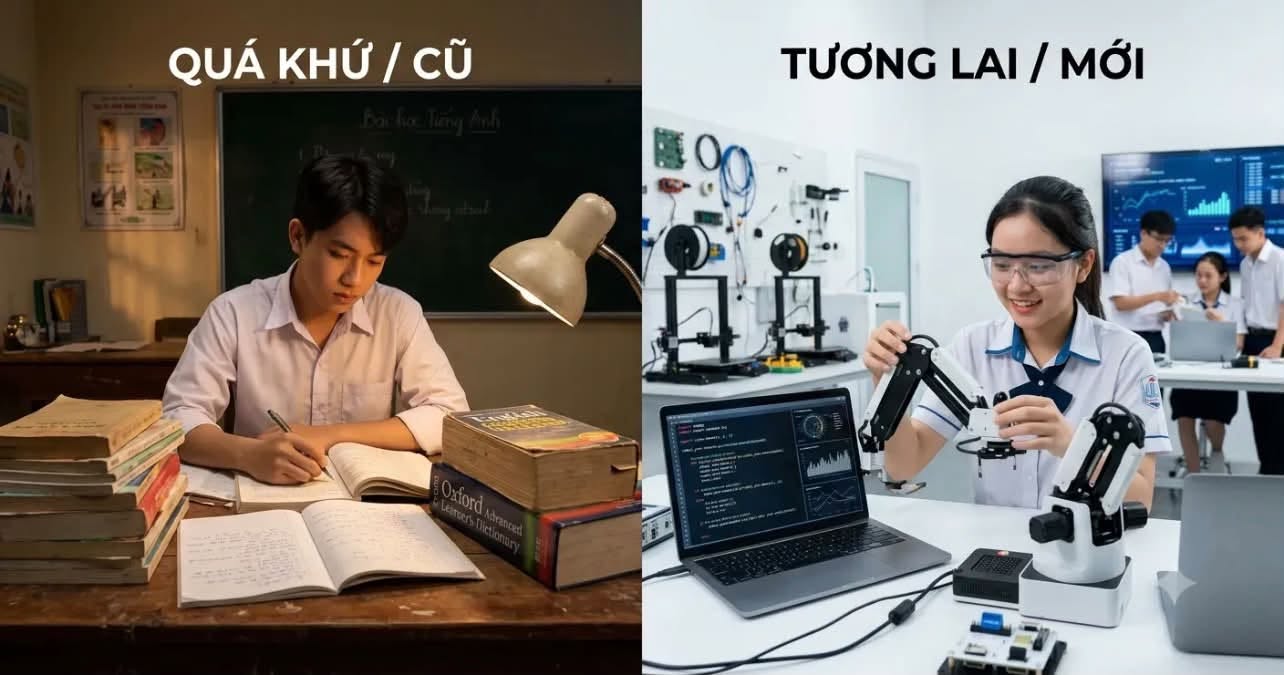
If Vietnam wishes to become a nation strong in science, technology, and innovation, we must boldly reform the specialized high school model and the way resources are allocated to develop talent.
Resources for talent development are always finite. Therefore, the State must prioritize investing in areas where the market cannot effectively train on its own or where it is too resource-intensive: areas that require both exceptional talent and a very lengthy training process starting from a young age.
1. ABOLISH “SPECIALIZED” CLASSES IN FOREIGN LANGUAGES, LITERATURE, HISTORY, GEOGRAPHY, AND SOCIAL SCIENCES
We need to be bold and determined to immediately abolish specialized classes in Foreign Languages, History, Geography, and Literature—especially specialized Foreign Language classes.
In the era of AI, proficiency in a foreign language has become a baseline requirement for every student, and it is increasingly supported by powerful AI tools. Therefore, continued state subsidies to train “foreign language specialists” are no longer necessary.
This is a “distortion” of the specialized school concept. It skews the objective of specialized schools away from discovering exceptional talent toward training skills that every student needs to possess.
Why should the country’s precious resources be devoted to specialized classes in foreign languages and social sciences from a very early stage—fields that do not inherently demand exceptional natural talent or intensive specialized training from the high school level?
I believe that students who are capable of passing the entrance exams for these “specialized” classes are more than capable of self-studying and excelling in these subjects within the standard high school curriculum. I truly cannot understand why we still need specialized English, specialized Chinese, or specialized Japanese, etc.
Proficiently using a foreign language today has become a baseline requirement for students in the technological era. In fact, with the support of AI, it has become infinitely easier. One can completely focus and master it within about two years.
How many people who studied in specialized language tracks actually go on to work in professions that strictly require deep foreign language expertise? I believe very few. No profession truly demands that someone study specialized foreign languages starting from 10th grade.
Decades ago, when the country had just opened its doors, we could argue that we needed to train highly proficient foreign language speakers to integrate with the world. But now Vietnam has opened up, deeply integrated, and developed tremendously. So why do we still have to continue subsidizing specialized foreign language classes? Where is the “specialization”? And where is the “giftedness”?
Years ago, despite studying in the specialized English track, every time I translated the name “HN Amsterdam for Gifted Students,” I felt embarrassed. I truly did not think I possessed any extraordinary talent. And then I “realized” something.
What we were pursuing was often not a specialized field. It was simply the two words: “specialized school” (trường chuyên). It could be specialized in anything: English, Russian, History, Geography, Chinese, Japanese, Korean, French, German… Those two words hold immense magic power.
I felt so proud to study at a school named “School for Gifted Students.” In reality, what parents need is very simple: a safe school; a strong brand; good quality teaching (not necessarily extraordinary); and a launching pad into university. It is not about being “specialized” in any specific subject.
Therefore, the State should not continue subsidizing specialized foreign language and social science classes. These programs can be transitioned into high-quality classes with tuition collected under an appropriate mechanism.
All saved resources should be concentrated into heavy investment for programs in basic sciences, technology, arts, and elite sports—fields that truly require exceptional natural talent and long-term training.
2. WHAT SHOULD A TRUE SPECIALIZED SCHOOL TRAIN?
In my view, specialized schools should focus exclusively on fields that demand both exceptional talent, long-term training, and an outstanding teaching faculty.
These fall into three domain groups:
a) Basic Sciences: Mathematics, Physics, Chemistry, Biology;
b) Future Science & Technology: Computer Science, AI, Robotics, and other foundational technologies;
c) Arts and Elite Sports.
This is also completely aligned with the spirit of Resolution 57 of the Politburo on science, technology, innovation, and national digital transformation.
Students who earn admission into these genuinely “specialized” programs must receive the heaviest investment, the utmost care, and every condition to fully develop their potential.
The goal is to place these students into world-leading universities such as MIT, Caltech, Tsinghua, Peking University, Oxford, Cambridge, or the most exceptional research programs in Vietnam.
They must be taught and inspired by world-class scientists such as Professor Ngo Bao Chau (Mathematics), Professor Vu Ha Van (Mathematics), Professor Dam Thanh Son (Physics), Dr. Bui Hai Hung (Artificial Intelligence), and many other outstanding scientists from Vietnam and around the world.
Alongside this, there must be strong development of specialized programs in performing arts (music, dance…) and elite sports (men’s and women’s football, swimming, golf, chess, dance-sport, running, tennis, etc.). These are all fields that require exceptional aptitude alongside training and rigorous practice spanning decades. However, we have yet to invest commensurately in these talents.
For students pursuing arts and elite sports, flexible learning models—such as online learning or hybrid learning—must be accepted so they have sufficient time to train and compete at the highest arenas and levels.
Students with exceptional talents in arts and sports need strong investment from the State to become Vietnam’s leading artists, creators, and athletes, capable of competing regionally and globally.
They can choose to become professional artists, professional athletes, or continue studying at top global universities with strengths in arts and sports, before returning to contribute to the nation.
Instead of merely taking pride in our small pond and struggling to handle national graduation exam scandals year after year, if we reallocate our resources starting today, after 20–30 years Vietnam will possess far more world-class scientists, engineers, artists, and athletes.
That is the true purpose of a specialized school system and the true spirit of Resolution 57.
Nguyen Quoc Toan