
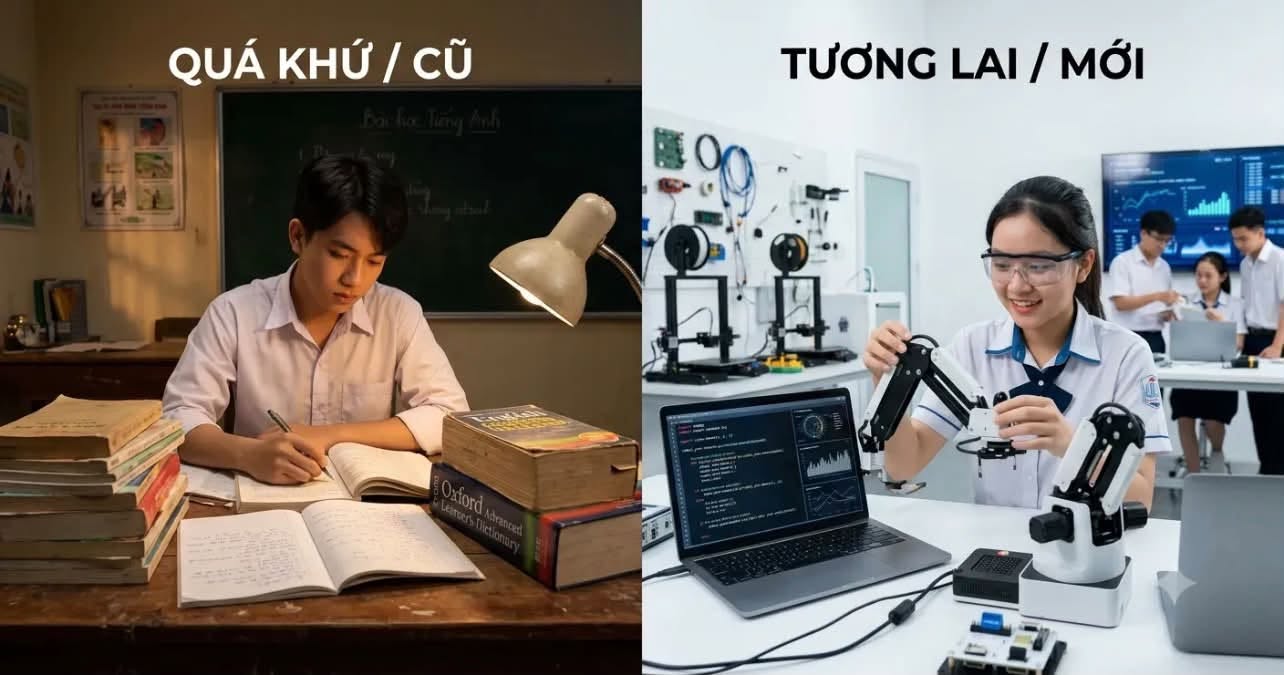
If Vietnam aims to become a powerhouse in science, technology, and innovation, we must boldly reform the specialized school (truong chuyen) model and rethink how resources are allocated to nurture talent.
Resources for talent development are inherently limited. Therefore, the State must prioritize investing in fields that the free market cannot train efficiently or that require excessive resources – specifically, areas that demand both extraordinary innate ability and a long-term training process starting from an early age.
1. Abolish Specialized Classes in Foreign Languages, Literature, History, Geography, and Social Sciences
We must be bold and decisive in immediately eliminating specialized tracks in foreign languages, history, geography, and literature – especially specialized language tracks.
In the AI era, proficiency in a foreign language has become a basic requirement for all students, further accelerated by powerful AI tools. Therefore, continued state subsidies for “specialized foreign language” training are no longer necessary.
This represents a distortion of the specialized school system. It shifts the core purpose of gifted schools from discovering exceptional talent to training skills that every student ought to have.
Why should the nation’s precious resources be spent on early specialized tracks in foreign languages and social sciences – fields that do not strictly require special talent or intensive specialized training at the high school level?
I believe students capable of passing the entrance exams for these “specialized” classes are more than capable of self-studying and excelling in these subjects within the standard curriculum. I simply cannot understand why we still maintain specialized tracks in English, Chinese, Japanese, and so forth.
Mastering a foreign language today is a baseline expectation for college students in the tech age. With AI assistance, it has become significantly easier – one can fully focus and master a language within about two years.
How many alumni of specialized language programs actually go on to pursue careers that require deep, specialized language expertise? I suspect very few. No profession genuinely requires specialized language training starting as early as 10th grade.
Decades ago, when the country was just opening up, an argument could be made for training highly proficient language specialists to integrate with the world. But today, Vietnam is fully open, deeply integrated, and developing rapidly. Why, then, do we continue subsidizing specialized language tracks? Where is the “specialization”? Where is the “giftedness”?
Years ago, despite studying specialized English, I used to feel embarrassed whenever I translated the name Hanoi – Amsterdam High School for the Gifted. I genuinely did not consider myself exceptionally talented. And then I realized something:
Often, what people are chasing isn’t a specific subject – it’s simply the prestige of the label “School for the Gifted.” It doesn’t matter what the specialization is: English, Russian, History, Geography, Chinese, Japanese, Korean, French, or German… Those words hold immense prestige.
There is great pride in attending an institution named a “School for Gifted Students.” In reality, what parents want is quite simple: a safe environment, a strong brand, good teaching quality (not necessarily extraordinary), and a launching pad into university. It is rarely about the “specialization” itself.
Consequently, the State should stop subsidizing specialized tracks in foreign languages and social sciences. These programs can be transitioned into high-quality general tracks with appropriate fee-based structures.
All saved resources should be redirected heavily toward basic sciences, technology, arts, and sports – fields that genuinely demand exceptional talent and long-term training.
2. What Should Specialized Schools Actually Teach?
In my view, specialized schools should focus exclusively on fields that require both exceptional innate talent, long-term training, and an outstanding teaching faculty.
These fall into three core categories:
- Basic Sciences: Mathematics, Physics, Chemistry, and Biology.
- Future Science & Technology: Computer Science, Artificial Intelligence, Robotics, and other foundational technologies.
- Elite Arts & Sports: High-level performance arts and elite athletics.
This aligns fully with the spirit of Resolution 57 of the Politburo on science, technology, national innovation, and digital transformation.
Students admitted to these true “specialized” programs must receive the strongest investment, the utmost care, and every condition necessary to fully maximize their potential.
The Goal: To send these students to world-leading universities – such as MIT, Caltech, Tsinghua, Peking University, Oxford, Cambridge or to top-tier research programs within Vietnam.
They should be taught and inspired by world-class scientists, such as Professor Ngô Bảo Châu (Mathematics), Professor Vũ Hà Văn (Mathematics), Professor Đàm Thanh Sơn (Physics), Dr. Bùi Hải Hưng (AI), and many other distinguished scientists from Vietnam and around the globe.
In parallel, we must strongly develop specialized programs in the performing arts (music, dance, etc.) and elite sports (men’s and women’s football, swimming, golf, chess, dancesport, track and field, tennis, etc.). These are fields requiring extraordinary natural talent and decades of rigorous training. Currently, however, we have not invested adequately in these talents.
For students pursuing elite arts and sports, flexible learning models – such as online or hybrid education – must be embraced so they have sufficient time to train and compete at the highest global levels.
Students with exceptional artistic or athletic talent deserve strong State investment to become Vietnam’s leading artists, creators, and athletes, fully capable of competing regionally and internationally.
They could choose to become professional artists or athletes, or continue their education at top global universities specializing in arts and sports, before returning to contribute to the nation.
Instead of remaining content with local pride and continuously dealing with annual high school graduation exam scandals, reallocating our resources starting today will, in 20 to 30 years, yield a generation of world-class Vietnamese scientists, engineers, artists, and athletes.
That is the true purpose of a gifted school system and the true spirit of Resolution 57.