
There is a core principle that anyone hovering at the upper echelons of power should learn by heart, or even tattoo onto themselves: “Never outshine the master.”
This is Law No. 1 in Robert Greene’s The 48 Laws of Power—a book that both entrepreneurs and politicians need to read like How to Win Friends and Influence People or the Bible.
I too once outshone the master—in just such a foolish way.
When I was young, leading a company, I made a fatal mistake: I publicly criticized my very close boss, saying he wasn’t talented enough to be the CEO and should just sit quietly as the owner. My boss lost face. And naturally, as close as we were, he showed me the door. No matter how talented I was, it could not salvage that foolishness.
From then on, I always reminded myself: never turn the boss into a laughingstock—even if speaking truly sincerely, with good intentions for the boss and the collective.
A decade later, when I sold my company to a new boss—who happened to be an older brother figure of mine—he invited me to the Metropole Hotel. Over dinner, he said gently: “We were brothers before, but now I’m the boss—you report to me.” I absolutely complied. No confusion. No misconceptions. This time, I understood life better.
These past few weeks, I think Elon Musk should re-read that book: In a stroke of madness and impulsiveness characteristic of the world’s richest man, Musk spoke out, criticizing Donald Trump: calling him ungrateful, faulting Trump’s policies, and even threatening to form an opposition party.
And that madness of Musk’s paid a heavy price.
With just a few policy changes by the Trump administration, Musk’s businesses stand to lose billions of dollars in revenue. In fact, before even doing so—they merely made threats—Musk’s net worth plummeted by tens of billions of USD. Companies like Tesla and SpaceX are all at risk of severe losses.
Just a few days later, Musk did a U-turn. He publicly apologized to Trump, expressing ultimate regret. Even the richest man in the world had a moment where he forgot that President Trump is actually the most powerful person in the world.
That is the story in America. A country called a “democracy.”
In Asia, Jack Ma is the most classic example of violating the “never outshine the master” principle.
At his peak, he was the symbol of Chinese prosperity. Alibaba was worth over 500 billion dollars, Ant Group was preparing for an IPO with a market cap of hundreds of billions, and Jack Ma himself was hailed by the international press as an “Asian Steve Jobs.”
Then he committed an unforgivable mistake: At a financial forum in Shanghai, Jack Ma publicly criticized the Chinese banking system as “outdated, having a pawnshop mentality, and hindering innovation.”
A few days later, Ant Group’s IPO was suspended. Jack Ma vanished—not a line of news, not a single public appearance.
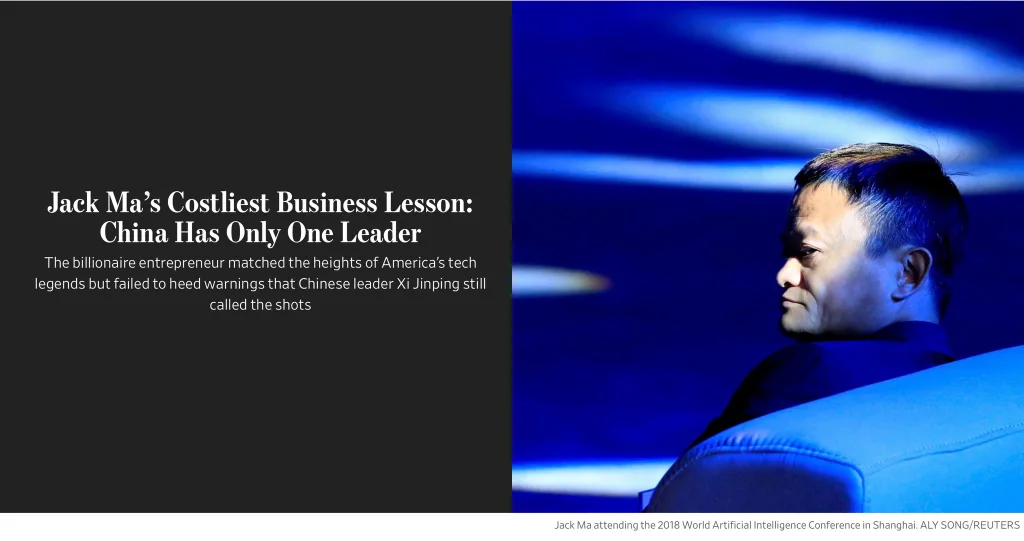
The Wall Street Journal ran a cold headline: “Jack Ma’s Costliest Business Lesson: China Has Only One Leader.”
In China, only one person is permitted to shine absolutely—and that is President Xi Jinping.
Political power is always greater than money or prestige. Between a top politician and a billionaire, never harbor the illusion that money can master the game.
If you have watched House of Cards, you will remember the scene where Frank Underwood—the Vice President and later President—said point-blank to Raymond Tusk, a billionaire kingmaker: “You may have all the money, but I have the guns and men.”
The power of public authority—whether under the name of democracy or autocracy—will crush the power of money and social prestige.
The same applies to geopolitical relations between large and small nations:
At the level of geopolitical relations, there is always a reality: small countries live in the shadow of large nations, heavily dependent both politically and economically, whether we call it “friendly relations,” “comprehensive strategic partnership,” or any other beautiful term.
Looking back at Vietnamese history: During the eras of King Le Loi and King Quang Trung—even after shattering the Ming and Qing armies—after victory, they always sent envoys to sue for peace using humble words like: “This subject accidentally engaged in combat with the Celestial Empire’s army; Your Majesty remains supreme. This subject begs to offer tribute, begs to become a son-in-law…”
Our nation’s kings understood all too well the consequences of “provoking” the ego of the “Son of Heaven.”
Within a country—whether a kingdom or a republic—power still holds an immutable principle: there is always one person at the top, and no one is permitted to overshadow that person.
Political power can be forgiving of opponents. But it never forgives those who mistake their role. Do not foolishly think that because you are important and influential, no one will dare touch you.
When you become a threat to the one holding power, you are already on the path to destruction.
Lu Buwei once manipulated the Qin state, but ultimately still had to drink poison and commit suicide. Fan Li was wise: after helping King Goujian of Yue restore the nation, he retired to wander among the mountains and rivers. Nguyen Trai retired to seclusion while retaining influence—and ultimately suffered the execution of three generations of his family.
In a company, the real master is the shareholder—not the CEO. No matter how talented the CEO is, they are not allowed to mistake themselves for the owner. Remember that you are still just an employee. Don’t be foolish enough to threaten shareholders with things like “if I quit, the company collapses,” or challenge them and throw tantrums.
They may forgive, but they will not forget.
I once witnessed a famous company in Vietnam whose market cap almost touched a billion dollars during its peak. The CEO of this company, despite holding less than 10% of shares, was very talented and thus always thought he was the true master.
He regarded the remaining shareholders as free-riders who understood nothing about operations and business. He frequently mocked and threatened them that he would ruin the company if they didn’t listen to him, because the staff belonged to him and he was everything. Initially, the shareholders endured it to keep the peace. But the more they endured, the more he pushed. And what had to happen happened; the shareholders could no longer tolerate it. They convened and decided to oust him from the CEO chair.
He struggled and fought, but in the end bitterly departed from the very company he founded.
Power does not forgive delusion.
Many people near the pinnacle of power and status often forget this. They forget that the privileges and perks they enjoy do not belong to them.
They are things granted by the boss/owner, the king/country, or the system and company they serve. But by the time they attain those privileges, they begin to harbor illusions: they forget who they are, believing they can stand alone, becoming self-satisfied without needing to respect the system they benefit from and live within.
And when you “outshine” the master, you are not merely challenging a person—you are challenging the very symbol of power of an entire system. If power is not respected and protected, the system will collapse.
Therefore, no system, no boss/owner, no sovereign monarch—no matter how wise and magnanimous—will ever allow that to happen.
Nguyen Quoc Toan
(Written out of empathy regarding the Elon Musk – Mr. Trump situation and human nature. Thanks to journalist KL for the feedback).