
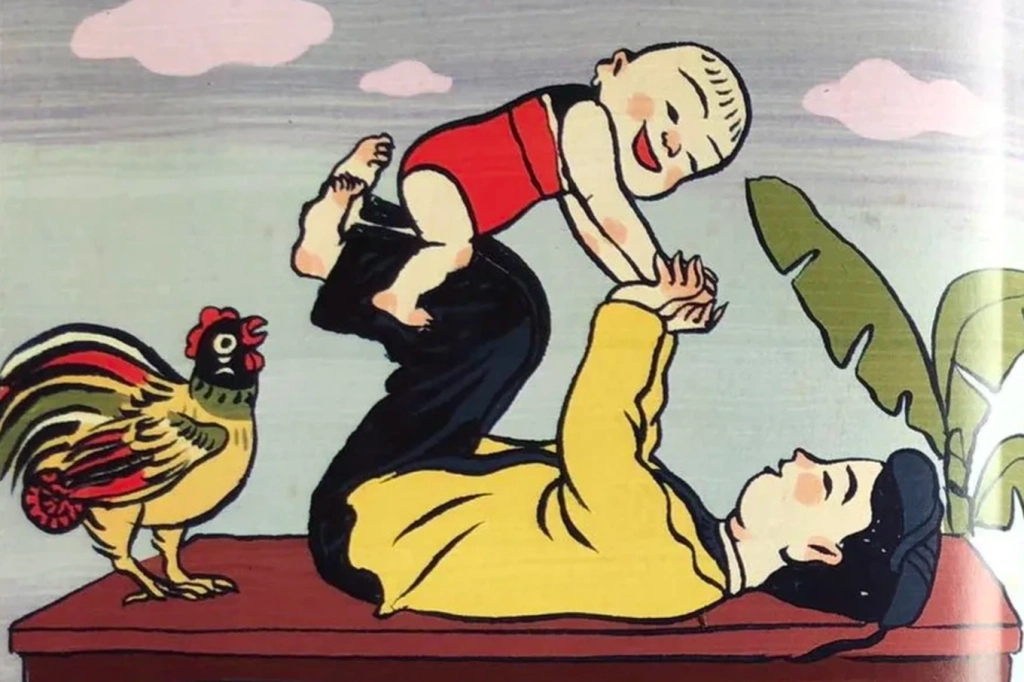
(Illustration for the nursery rhyme “Threshing Rice, Cooking Rice” – Photo taken from the book).
Is there anyone who doesn’t lie?
Try imagining it like this: Your family is poor. Extremely poor. One day, your household has only a single cup of rice left to feed a very young child. At that moment, a neighbor who is equally poor comes over to borrow rice: How would you answer?
Perhaps 99% of people would answer that there is no rice left, because you need to keep those last grains of rice for your child. But you also don’t want the neighbor to feel hurt. So you lie…
If anyone has lived through the subsidy years, when having a bowl of white rice without mixed corn was already happiness, and eating a bowl of pho was a grand dream… then they would understand this feeling.
Last month, public opinion was once again noisy over a nursery rhyme printed in a reference book, because it was believed to teach children how to lie:
“Threshing rice, cooking lunch rice/ If there’s leftover, keep it till evening/ If someone asks to borrow, then lie/ My house is out of rice/ Tilt the mortar up!”

(The nursery rhyme “Threshing Rice, Cooking Rice” is located in the book “Nung Nung Na Na” from the book series “Nursery Rhymes for Babies” published by Kim Dong Publishing House, printed in 2022. This work is the origin of online debates – Photo taken from the book.
And so we demand to remove it, forbidding its publication further.. In reality, removing a nursery rhyme and replacing it with another might not be a minor matter. But the perspective asserting that verses like these are anti-educational and teach children to lie is also truly one-sided.
Please do not stigmatize the act of lying, because lying is a natural human instinct, just as humans are born needing to breathe.
According to research, children begin to know how to “lie” as early as 6 months old, even earlier than when they know how to speak. At that time, infants can pretend to cry to attract adult attention. By age 2, lying becomes more sophisticated to protect themselves from parental punishment when they make a mistake.
What about adults? Much “worse”! When releasing Season 1 of the TV series “Lie to Me,” 20th Century Fox conducted a survey and uncovered an interesting fact: on average, in a week, a man lies to his wife, lover, and colleagues 6 times.
Thus, their frequency of lying is 2,184 times a year and about 126,672 times in a lifetime. Women are a bit more “modest,” lying on average 3 times a day, 1,092 times a year, and 68,796 times in a lifetime—half as much as men. Yet only 12% of adults dare to frankly admit that they lie frequently…
Does it sound scary? But it is true!
Therefore, no matter how much we long for our children to be honest, no matter how much day in and day out we preach to our children about the nobility of honesty, we cannot deny that lying is a human instinct. No need to teach it, and impossible to forbid it.
People lie for many different reasons, and lying is not necessarily a completely bad or good action; it depends on context and motivation.
Franklin D. Roosevelt, the only person in American history to serve as President for 4 terms (from 1933 to 1945). Roosevelt began his presidency when the largest Great Depression in US history had reached its peak. He revived the American economy, and then led the United States through almost the entire period of World War II.
Throughout his 12 years as President, he “joined hands” with the American press to execute a “lie” that lasted across 4 terms: concealing the fact that he was paralyzed. This was so that the American public would hold firm confidence that the head of the United States possessed enough strength to steer the country through immensely arduous years.
Only after his passing was a photograph showing Roosevelt paralyzed published by the press for the first time. Only then did the American people learn that their revered President had to use a wheelchair.
Despite being “deceived” for 12 years, the American people were not angry and did not condemn that grand lie, because of the deeply noble motivation hidden behind it.
Parents hope their children become angels, but where in life is there a place for angels?
Returning to the act of lying, according to some scientists, lying is necessary in the cognitive development process of young children.
From a social development perspective, as children grow up, they learn social rules and seek ways to integrate into them. Learning how to lie is a process where they test boundaries to draw lessons for themselves; it is also something that sometimes must be done for self-defense, avoiding conflict with people around them, especially before those in power.
There are several motivations leading to lying in young children:
- Lying to avoid punishment or loss of privileges.
- Children may lie to gain praise or to fit in with their peers; for example, children might exaggerate achievements or fabricate stories to make themselves look better.
- Some lies can originate from a child’s rich imagination. Children often engage in imaginative play, in which they can temporarily pretend to be someone or something they are not. This form of lying is a natural part of creative play. At times, they will transform themselves into a superhero, a princess, or a flying bird.
- Children may lie to protect their privacy, especially as they enter adolescence. At that stage, they may conceal personal thoughts, feelings, or experiences from adults.
In the lifelong “lying journey,” from the age of 6 months, a child will gradually mature, learning to distinguish right from wrong, gain from loss, as well as the differing consequences of lies with different motivations.
Therefore, the job of education—of parents and teachers—is not to forbid children from lying or to shun all lies, but to help the child understand the impact of their lies, distinguishing which lie is harmless and which lie hurts others.
For instance, when a lie is spoken to protect oneself from an unnecessary danger, it proves you know how to defend yourself. When you compliment someone’s new hairstyle as pretty, even though you don’t actually think so, it proves you care about other people’s feelings. When you conceal from a father with heart disease that his son was in a severe accident, that is a lie stemming from compassion.
Parents and teachers can encourage children to be honest to build strong relationships. But they also cannot forget learning how to balance honesty with diplomatic skills, helping relationships avoid shattering due to excessive blunt honesty.
Therefore, do not condemn a nursery rhyme simply because it is thought to teach children to lie. Nor think that lying is some evil thing that children cannot learn or do. Because we ourselves lie every single day!
This is not the first time that parents have reacted to “anti-educational” elements that folk songs and fairy tales teach their children, believing those teach children bad habits.
There was a time when we condemned the fairy tale “Tam Cam” because Lady Tam’s revenge was too brutal, demanding that it be revised. Exactly as wished, one of the endings of the Tam Cam story was revised to: “Cam and her mother went back to their hometown and were struck dead by lightning,” instead of the original ending: “Cam was turned into salted fish paste and sent to Cam’s mother to eat. Cam’s mother discovered her daughter’s remains and fell over dead.”
We found the first outcome immensely brutal and anti-educational, so we did not want our children or anyone else to read about that outcome.

Illustration of the fairy tale “Tấm Cám” by Trẻ Publishing House (Screenshot).
Yet think back about it. That “brutal” outcome was actually very logical and easy to accept at that time.
- We condemn how sweet Lady Tam killed her half-sister and stepmother. But we forget that when Cam and her mother conspired to harm and kill Lady Tam 4 consecutive times, they were already murderers with a multitude of crimes.
- Lady Tam was the queen. And committing a crime against the queen is the crime of “lèse-majesté.” In ancient times, killing the king/queen resulted in dismemberment and the execution of three generations of the family, even if the offender was royal kin. Here, in her capacity as queen, Tam spared the lives of Cam and her mother many times. The final time, Tam executing Cam was completely legal and perhaps contained no brutality according to ancient laws.
- Suppose Lady Tam did not retaliate and let Cam and her mother walk away. Then that vicious cycle of crime would continue forever: Tam would continue to be killed. Because Tam had been benevolent 4 times already, and each time paid an equally heavy price. Only upon being killed for the 4th time did Lady Tam know how to fight back and defend herself.
If your child were Lady Tam and repeatedly harmed by evil people, would you want your child to know how to defend themselves, or want them to remain angels forever, sitting weeping with covered faces when bullied, waiting for Buddha to appear and ask, “Why are you crying?” Where in life are there so many Buddhas to constantly protect such good-natured angels? Lady Tam finally realized this truth, so she defended herself as done in the original version.
Lady Tam’s resistance is actually very close to the character of Vietnamese people: a gentle nation, yet ready to rise up fiercely against enemies and then return to being gentle.
There is an explanation for Tam’s harsh retaliatory behavior through the lens of game theory. Game theory has a strategy called “Grim strategy.”
In the Grim strategy, a player begins by cooperating (being the decent person in the Tam Cam story) but will switch to a response strategy of maximum retaliation if the opponent abandons cooperation.
The idea behind this strategy is to deter the opponent from initiating any attack or breach of cooperation, because the consequence of doing so is a severe and relentless response from the opponent’s side. It essentially forces the opponent to cooperate by threatening extreme retaliation against any violation.
Folklore provided such a brutal end to Tam’s revenge so that evil could never repeat itself. Because cruelty would be answered with multiplied ruthlessness, so the opponent no longer exists or dares to play dirty again. Lady Tam in the fairy tale decided she had to retaliate to the extent that evil people like Cam and her mother would no longer dare think of harming good people.
Straying from the nursery rhyme about hiding rice to the story of “Tam Cam,” I only wish to say one thing: please do not rush to react whenever seeing a nursery rhyme, poem, or story with content slightly different from common norms. Look at matters in historical context, multidimensionally, and through the logical and dialectical nature of the situation before criticizing.
We want to turn our children into angels, but this life has no place for angels. Forbidding children from accessing multi-colored life and failing to teach children to view life multidimensionally and with positive critical thinking will also diminish our children’s chances of success when growing up.
PS: Thank you, Dan Tri Newspaper, for publishing the article. Thank you, Ms. To Lan Huong for editing the article; thank you, journalist Mai Cham, for proofreading and publishing.
(Article published on Dan Tri Newspaper).