
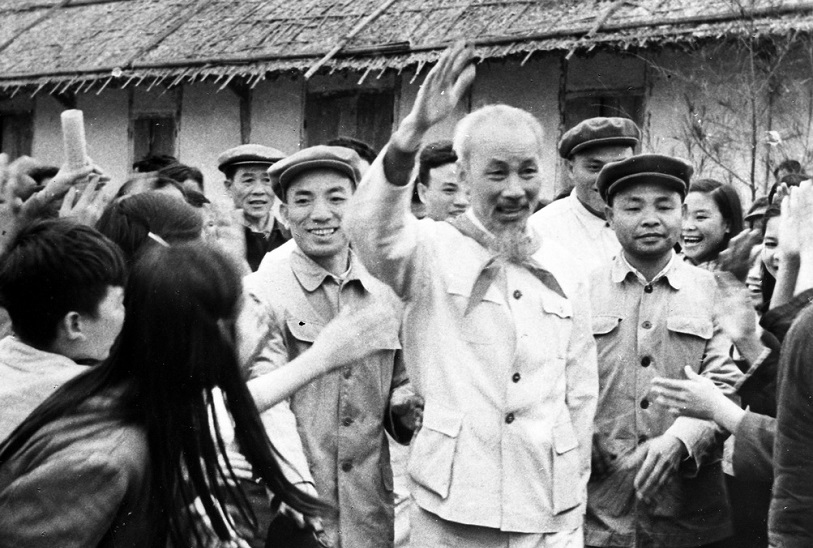
Having time to sit down and analyze Uncle Ho’s leadership style through modern management language, I admire Him even more, and I have also learned many things from Him. I would like to share a few major lessons gained from President Ho’s way of leading:
1. HAVING A CLEAR VISION AND BEING OBSESSED WITH THAT VISION
Uncle Ho always clearly demonstrated his purpose and vision. He was particularly obsessed with and communicated that purpose extremely well to those following Him. He had many famous quotes, but one of the quotes that impressed me the most is: “No matter how great the sacrifice, even if we have to burn down the entire Truong Son range, we must resolutely win back independence.”
This statement of His demonstrated an ironclad, firm will regarding a unified Vietnam. It also showed the leader’s ultimate obsession with the vision and the organizational leader’s commitment to achieving that vision.
2. GOVERNANCE: FOCUSING DEFINITIVELY AND GOVERNING BY OKRs/KPIs
a) Resolving key issues definitively
A leader cannot lose focus. At any given point in time, one needs to know how to identify what is central to resolve so that all matters run smoothly.
After independence day in 1945, the first decision of the young Vietnamese state was not economic development, nor was it the military. In the first meeting on September 3, 1945, President Ho Chi Minh proposed launching the “Eradicate Illiteracy” campaign, viewing “illiteracy” as a national disaster with the statement: “An ignorant nation is a weak nation.”
Uncle Ho’s declaration struck at the self-respect and pride of the entire nation, creating a powerful wave of learning to read and write. Classes were established everywhere, in communal houses and temples, at home, at market gates… Tens of thousands of people volunteered to teach without pay. And so a young government without resources, within just 2 years, almost entirely eliminated illiteracy. By the end of 1946, Northern Vietnam gained over 2.5 million more literate people. That was an educational miracle that we achieved over the past 100 years or so.
When leading and managing, Uncle Ho knew how to focus on resolving one thing—just one thing—but it was the most crucial point, creating a powerful transformation in society or the organization.
b) Governing by OKRs/KPIs
One of the modern governance theories is governing by KPIs (Key Performance Indicators) and OKRs (Objectives and Key Results).
These are very modern and effective management concepts. Not every organization successfully applies these governance models. But perhaps Uncle Ho applied these methods quite clearly, though back then I guess He had no idea what OKRs were; a person with innate leadership talent naturally knows how to do the right thing.
For example, the OKRs regarding building a Vietnamese country, in Uncle Ho’s words, were very clear:
- The country is completely independent;
- The people are completely free;
- Compatriots have food to eat, clothes to wear, and are educated.
His OKRs were very easy to understand, without flashiness, easily quantified, and measurable.
3. TALENT MANAGEMENT IS THE ESSENCE OF SUCCESS
In modern management, talent management in simple terms means knowing how to use people, reward people, and build a line of successors.
a) Promotion policy
One of the major challenges of talent management is promotion policy and talent evaluation. This policy needs to be designed simply, understandably, challenging enough, and easily determined. And Uncle Ho accomplished that very naturally in His policy of bestowing General ranks.
There was a time when a foreign reporter asked why so many generals and officers were promoted in one rank-bestowing ceremony, and He replied: “Whoever defeats a Colonel is appointed a Colonel; whoever defeats a Major General is appointed a Major General; whoever defeats a Lieutenant General is appointed a Lieutenant General; whoever defeats a General is appointed a General.”
The answer was very clear, very distinct, and could not be better!
It is truly fascinating, because indeed, when reaching a certain metric, one gets promoted. If one possesses sufficient talent to win a major battle led by an enemy general, it is completely understandable that the force commander on our side is considered equal to a general.
b) Planning successors really well (Successor planning)
Talent Management capacity is also reflected in choosing a successor. A correct successor selection strategy exists only when that person best executes the vision and aspiration of the organization, rather than out of love/hatred or personal interest. Uncle Ho’s vision at that time was national reunification. And he chose Mr. Le Duan as the person to execute that strategy and vision.
In 1957, Mr. Le Duan went to the North and later became the First Secretary to the surprise of many people. Because everyone thought Uncle Ho would choose Mr. Vo Nguyen Giap or Mr. Pham Van Dong (close pupils by His side), rather than choosing Mr. Le Duan – who at that time operated mainly in the South and had met Him only once in 10 years.
But nobody understood the Southern revolution better than Mr. Le Duan, and perhaps nobody was more decisive regarding the liberation of the South than him, so perhaps that was the reason why Mr. Le Duan was the chosen one. The most admirable thing about Uncle Ho was that when He (seemed to be) sidelined regarding power during His final years of life, He did not choose to act as a Paramount Ruler (Thai Thuong Hoang) but fulfilled His exact role, letting Mr. Le Duan hold the highest decision-making power over the cause of liberating the South.
(This segment I wrote according to my memory of reading somewhere. If there are inaccuracies or if it resembles someone else’s writing, please excuse me)
4. TOP-TIER COMMUNICATION/WRITING CAPACITY
Communication and interaction capacity is an indispensable quality of an outstanding figurehead/leader. You will never be able to mobilize large numbers of followers if you lack the capability to communicate and rally the masses/associates.
Uncle Ho’s written pages/spoken words possessed tremendous power to move millions of Vietnamese people. He always wrote/spoke very simply, with clear points, without fancy embellishments so that anyone could understand, and particularly full of authentic emotion.
Read His masterpieces, “The Declaration of Independence” and “Appeal for National Resistance.” No one can fail to burn with fighting spirit when reading such moving call-to-arms words: “No! We would rather sacrifice everything than lose our country, than be enslaved. Compatriots, we must rise up!…”.
When He read the Declaration of Independence, 90% of the population was still illiterate, yet anyone could easily understand His message. The Declaration began by quoting the US Constitution, demonstrating the political view/philosophical foundation of the Vietnamese government for its actions (not that He lacked philosophy).
Regarding writing style, the Declaration used simple sentences without cliches, repeating sentences to heighten emotion: “A people who have courageously opposed French slavery for more than eighty years, a people who have courageously stood on the Allied side against fascism for these past few years, that people must be free! That people must be independent!”
How many leaders of organizations today can write like Him?
5. HUMILITY
Uncle Ho’s humility and simplicity surely need no further discussion. Although the press and media always praised and sanctified Him, Uncle Ho certainly did not want such a lifestyle. He smoked, dressed simply, strictly avoided formalities, and most importantly, He never governed the country in an autocratic manner to retain perks for Himself like many other totalitarian dictators.
He also did not demand the construction of a mausoleum for Himself, nor did He ever support cheering whenever He arrived. I have never seen a photo taken of Uncle Ho visiting anywhere that displayed a sign saying “Warmly welcome President Ho Chi Minh to visit and work at….” as many current leaders joyfully accept.
Jim Collins, author of the famous book “From Good to Great,” is well-known for his “Level 5 Leadership Theory,” positing that there are 5 levels to classify a leader:
- Level 1: Highly Capable Individual
- Level 2: Contributing Team Member
- Level 3: Competent Manager
- Level 4: Effective Leader
- Level 5: Great Leader
According to this theory, Uncle Ho’s leadership style would be classified into the 5th level: in these leaders, there is a rare and special combination of ultimate ambition, ultimate will, and great humility. Their ambition is vast, but not for personal purposes, always for the organization and the common purpose.
Fellow leaders, let us learn from Uncle Ho’s example!
Nguyen Quoc Toan