
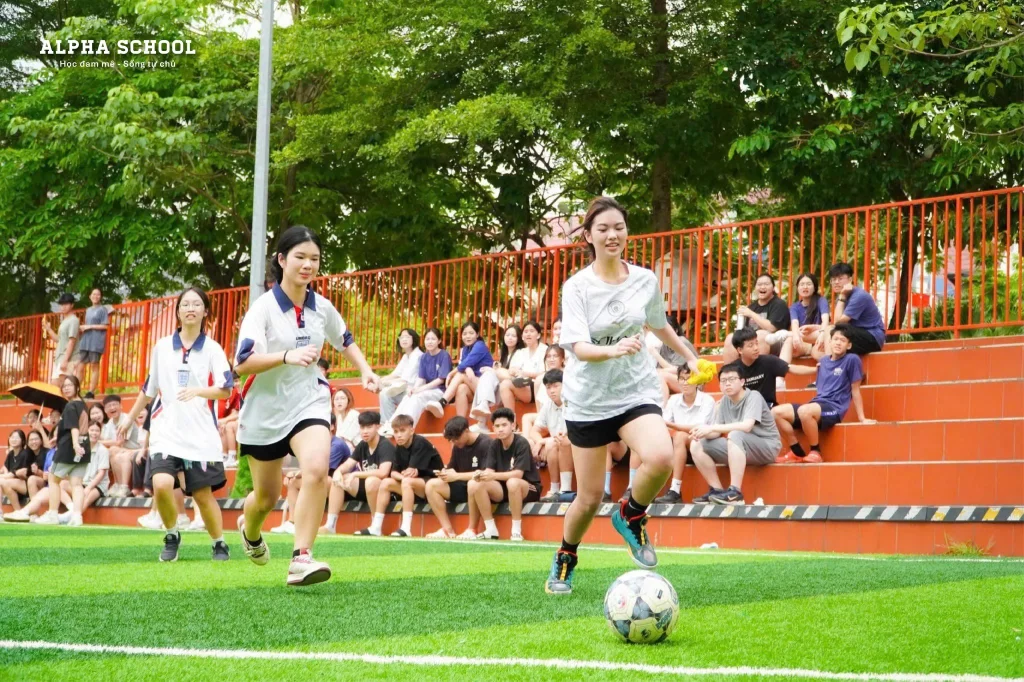
Photo: Alpha School students
Many people ask for my advice on whether they should transfer their child, who is currently studying at an advanced private school in my system, to several prestigious specialized schools that they have recently been admitted to.
Frankly speaking, this is a question that makes me ponder quite a lot – not only because this is a crucial decision for the young students’ futures, but because I myself have a conflict of interest. However, after questioning myself for quite a long time, with the experience of someone who attended a specialized school and also has a child attending university alongside former specialized school students, I would like to share my personal perspective in the most sincere way:
“If you do not have the financial conditions to attend a private school, you should definitely transfer your child to a public specialized school. However, if you have the financial conditions, even if you have to stretch a little, you should keep your child at their current private school.”
And here are the specific reasons:
1. Don’t fix what is working well
The British have a saying: “If it ain’t broke, don’t fix it.” Which means: “If something is going smoothly, do not try to change it.”
If your child is studying at a good private school and has just passed the entrance exam for a prestigious specialized school, that proves the current educational environment of the private school is doing a very good job in academic training for your child. So why “trade off” to bring your child into a new environment full of unknown risks, where it is not even certain that your child will study better?
Transferring schools at this point is a gamble: it could be better, but it could also disrupt the ecosystem in which your child is developing very harmoniously.
2. The “Big-Fish-Little-Pond” Effect
The “Big-Fish-Little-Pond Effect” shows that good students in a moderate environment are often more confident and motivated to learn. Herbert Marsh’s research points out that social comparison in a highly competitive environment can diminish self-esteem. This phenomenon does not deny the value of specialized schools, but warns of psychological risks for students in a stress-filled environment full of “super sharks,” where everyone is talented – even more so than you.
The self-esteem of students ranked at the bottom will be severely affected. Instead of becoming top students in an environment with average-performing students, these good students might end up at the bottom of the class at a school full of outstanding students.
Learning motivation will disappear and give way to pressure and stress. Quite often, those very pressures will kill a child’s creativity, passion, and joy of learning. It is estimated that only about 30% of top-ranking students in a cohort will truly succeed; the bottom 30% usually end up feeling inadequate compared to their classmates and consequently suffer heavy pressure on themselves.
Back when I was in Australia, one of my wisest decisions was choosing to study at a very ordinary university. However, I was one of the top-performing students in that cohort, allowed by the university to study and graduate quickly with quite high grades. And that created immensely favorable conditions for me. Being a “big fish in a small pond” helped me become far more confident and study much better during my higher studies, as well as in my subsequent work and career.
Advanced private schools meeting accreditation standards always have a fairly good school psychology office to help students overcome stress during their study time, rather than having to cope alone or face social stigma for being a good student who needs psychological help.
Therefore, if you do not truly belong to the top elite group of the entire city and are not under financial pressure, there is no reason to enter an environment where you always feel pressured and stressed.
3. Advantage in national, international competitions and university admissions
Many parents think that studying at a specialized school makes it easier to enter university. But reality has changed. Top universities in the US, Europe, and even Vietnam now do not just look at grades. They want to know what students have done, how they have lived, what skills they have, and what passions they possess. Participating in extracurricular activities, research, volunteering, sports… carries an equally high – or even higher – weight compared to GPA.
Private school students have a more flexible schedule – and therefore have more time to invest in activities outside the classroom.
Unless you are extremely outstanding academically, every university wants to admit students who have played sports for school teams. There is a fairly clear connection between performing well in university, life success, and the ability to play a certain sport well. And on this point, I believe private schools far surpass public schools.
Some parents worry that studying at a private school means being unable to participate in exams or lacking good teachers to prep for national and international competitions. This is a very outdated view. Private schools in the EQuest system, such as Newton, Ngoi Sao, CIS, and Einstein HCMC, are always in the top group of schools with students competing in national and international awards, competing on equal footing with specialized schools. The financial resources of private schools allow them to invite outstanding teachers and professors, and access advanced technology much faster (partly because they do not have to worry too much about procedures and policies like the public sector).
4. Private schools can help children grow… taller in stature and healthier
The final reason – and to me personally, a very important reason. I have an impression (without clear verification or statistics) that on average, if attending an advanced private school, students will be taller and healthier than when attending a public specialized school.
It may sound absurd, but I find this very much worth noting. Height and good health bring many advantages in later life – something no one can deny.
When I visit specialized schools, one thing I find quite concerning is that many students still look quite small and thin. Students at schools in our system are genuinely taller on average.
Why do private school students have an advantage in physical stature and height? I can explain this through three main factors:
First is nutrition. There is certainly a statistical bias, because private school students generally have better financial conditions, so home nutrition may also be better. As for at school, the quality of school meals at advanced private schools is clearly better, partly because costs are not flat-rated or capped as in public schools. Meal portions at private schools usually range from 60,000–100.000 VND/day, whereas meal portions at public schools usually cost much less (35,000–45,000 VND/day).
The second reason is sleep. Science has definitively proven that adequate sleep plays an absolutely crucial role in a child’s height growth during puberty. At ages 13–18, teenagers need 8 to 10 hours of sleep per day. Most growth hormone (GH) is secreted during sleep. Adolescents who get sufficient and regular sleep every day will have significantly higher GH secretion levels compared to the chronically sleep-deprived group.
I strongly believe private school students have a clear advantage in getting enough sleep.
The first cause is long-distance commuting: not every specialized school is near home, and there are only a few specialized schools in the entire city, so many students lose 45 minutes to 1 hour per trip on the vehicle. A day loses up to 2 hours just traveling – and that is very disadvantageous for height growth because they have to wake up very early (while specialized schools often start classes very early). Meanwhile, parents usually choose private schools near home, convenient for travel, or starting later.
Second, due to academic pressure, specialized school students often have to stay up late. Specialized schools face immense exam pressure, added to peer pressure from classmates, forcing them to study more and attend more periods. The number of subjects is also not as flexible as in private schools, so many students frequently stay up late and do not get enough sleep. This is clearly very harmful to height development.
The third reason: private school students have more conditions to play sports. Part of it is due to smaller class sizes, making physical activities easier to organize. Part of it is that exam pressure in private schools is less, so students have time to move around. Besides, sports facilities at advanced private schools are also usually better, with more grounds and more clubs.
Therefore, I judge subjectively that, in terms of height and physical development, students at advanced private schools in Vietnam have many more advantages compared to choosing to attend a specialized school.
And when height is tied to confidence, career opportunities, both physical and mental well-being – education cannot merely look at test scores.
5. Choose for your child’s real benefit – not for adults’ expectations or your child’s “peer pressure”
Many decisions to transfer children into specialized schools sometimes stem from parents’ very natural desire – wishing for their child to be “recognized,” to be “equal to peers,” and for the whole family to be proud. What parent does not want the best for their child?
However, often “pride” and “ego” are not the right or most beneficial things in the long run for young people. Children may have to trade it off with fatigue, sleep deprivation, lack of exercise, constant stress, and sometimes putting aside personal hobbies. In the end, the child still enters university – like many other peers – after a 3-year journey of unnecessary pressure.
If you have financial capability, your child is studying well at a quality private school, developing holistically, and feeling happy every day coming to class, then transferring your child to a specialized school is not necessarily an upgrade – and sometimes even breaks a precious state of balance.
If you want your child to be more confident – let them be a “big fish in a medium pond.” If you want your child to grow taller – let them get enough sleep, eat well, and exercise sufficiently; if you want your child to develop holistically – do not let them be submerged in the grade race.
Every child has their own running track. And choosing a school – sometimes – is choosing to run fast, or to run far.
Look at the long road ahead.
Nguyen Quoc Toan
(This article reflects the author’s personal, subjective views. Thanks to Thanh Nien Newspaper for publishing most of the content)