
(Co-authors: Nguyen Quoc Toan, ChatGPT, and Deep Dream)
Tam was a financial consultant highly regarded by the business community for his ability to raise capital and restructure struggling companies. One day, a new client approached him. This company was in a consumer industry with great potential, but was currently struggling to maintain their business operations. Tam took on the project with great excitement.
He worked long hours with the client and devised plans to salvage their business. Tam’s relationship with the client became so close and personal that Tam spent his personal assets to help that company.
Khanh, his partner, became increasingly worried and warned Tam about many unusual signs regarding the client and their reputation. However, Tam’s relationship with the client was already so deeply involved that Tam was completely blinded. He was determined to prove to his associates that he could solve any problem. He repeatedly confronted Khanh.
However, things soon turned sour. Despite Tam’s best efforts, the client company continued to face difficulties. Capital could not be raised, and the company’s reputation declined to the point of gradually losing market share.
Tam’s family began to experience tension due to the long working hours, Tam’s use of personal money, and his obsession with being unable to fail. Tam’s business partner, Khanh, became increasingly disappointed. And when the client company collapsed, Khanh could not bear it any longer and left in anger. Tam’s personal and professional life was virtually destroyed. Tam and Khanh were never friends and partners again.
At a certain industrial manufacturing conglomerate, there was a leader named Thang. People admired him for his erudition and decisive personality. Thang was responsible for a very large business division in the company. This business division had a team of subordinates who were quite outstanding. They welcomed him with enthusiasm.
With his strong personality and seasoned experience, Thang wanted to prove to the board of directors (BOD) that he could achieve quick success with the new plan. Thang rushed into pushing business without listening to opinions and ignored the criticisms of his subordinates. All opinions went through Thang like “water off a duck’s back”; he insisted on doing everything his way, even when reality showed that his approach was not effective at all.
As time passed, Thang’s team became demotivated because their opinions were not heard. Some partners refused to work with his division. The market was at risk of being lost. Despite warnings and pleas from subordinates, his direct boss, and the BOD, Thang ignored the issues and blindly believed he would compensate for the lost revenue and clients by continuing to push his current strategy more aggressively.
In the end, his division disintegrated due to lost morale, and revenue fell to a fraction of the plan. The BOD went crazy and severely criticized his boss for overprotecting him. His senior staff either left or were poised to submit their resignation letters. The whole team was left in turmoil. Thang’s reputation and competence were severely diminished and questioned.
Thuy was a good leader in the fast-moving consumer goods industry. She had built a business division from scratch into a well-known brand. With her hard work and excellence, Thuy was respected by her subordinates and liked by her boss. She was considered a rising star and was even implicitly chosen by her bosses and the BOD as a future successor.
However, Thuy had a personal difficulty that she did not share with anyone. For over two years, Thuy kept her problem secret and tried to handle it herself. However, as time passed, her problem grew increasingly severe and began to affect her decision-making ability at work and in life. Instead of seeking help from friends and colleagues/boss, Thuy kept blindly fumbling for ways to solve it alone. The boundary between her personal and professional life blurred. Thuy began making mistakes with both her family and the company in her effort to resolve her issues.
Thuy was fired by the company and lost everything she had worked so hard to build over many years. Her rapid downfall was a major shock to her family, boss, and colleagues, who had always viewed her as a capable leader. They were very sad because she had not turned to them for help; instead, Thuy buried herself deeper and struggled on her own to resolve things the old way, hoping they would pass.
I myself was the blinded character Tam in that first story, 12 years ago. The other two stories are also completely real at two companies belonging to my friends.
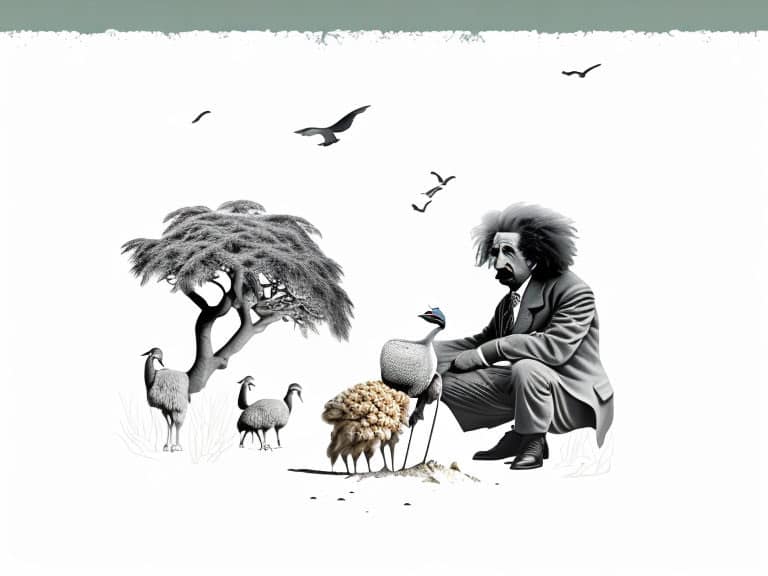
The stories of Tam, Thang, and Thuy are three stories illustrating different forms of what is called the Ostrich effect and Einstein insanity (because rumor has it that Albert Einstein defined this concept of “insanity” that way).
Like an ostrich that only knows how to bury its head in the sand when encountering danger, a person affected by the Ostrich effect often refuses to acknowledge the severity of their problems. They ignore warning signs and continue working the old way in the “insane” hope that problems will vanish over time. However, in reality, problems usually only become aggravated, and continuing to follow the old way (in an “insane” manner) can cause severe consequences.
How is “insanity” defined? “Insanity” means: doing the same thing over and over again and expecting different results. (“Insanity is doing the same thing over and over again and expecting different results”). We frequently fall into the “insanity” trap by trying to use only one solution for a problem in the hope of achieving a different result.
For instance, like how I used to blindly manage to help an enterprise that no longer had opportunities and reputation in the marketplace, only to lose almost everything. Like Mr. Thang, who turned a deaf ear to all criticism regarding his management style and continued along the old operational and business rut. Like Ms. Thuy, who should have immediately told her family and boss about her problem, but instead quietly resolved it herself using the old way for 2 whole years. Those are manifestations of “insanity” as defined above.
The Ostrich effect and insane actions (Insanity) are a dangerous trap that can lead the most capable and successful individuals onto a path of self-destruction and cause the collapse of the organization they lead.
Therefore, proactively seek help and support when facing challenges and difficulties, whether they are personal or professional issues. The important thing is to recognize that the problem will not go away, no matter how deep you try to bury and ignore it. You must have the courage to face it, and most importantly, seek help from your friends, family, and superiors as early as possible.
Do not be infatuated and conservatively insist on a single solution. And always remember that you are not God. You cannot solve every problem. And you are not weak at all when seeking help.
(Nguyen Quoc Toan – EQuest Education – Article using ChatGPT for initial drafting and Deep Dream for drawing illustration pictures)