
PART 1: WHEN TRUST IS STOLEN
(Warning Signs from Southeast Asia and Vietnam)
a) From eFishery to the Domino Effect on Trust
eFishery—an Indonesian aquaculture tech unicorn—was once valued at $1.4 billion, attracting hundreds of millions of USD from major investment funds such as SoftBank, Temasek, and Sequoia. However, the company became embroiled in a scandal involving the inflation of revenue by hundreds of millions of US dollars and reporting profits instead of losses for the first nine months of 2024. As a result, major funds are highly likely to lose everything.
The eFishery scandal triggered a wave of skepticism among investors. Many foreign investors delayed capital injections, extended due diligence periods, or temporarily suspended operations in the region due to fears that similar fraud could recur.
Justin Hall, a partner at Golden Gate Ventures, commented: “I think Southeast Asia has definitely taken a hit reputationally. But the companies that are going to suffer the most are going to be growth-stage companies in Indonesia. Even good companies are going to be scrutinized much more heavily—to the point where some investors will have to consider whether it’s worth all the trouble to invest in Indonesia.”
b) Lost Trust—Not Just One Company, but the Whole Economy Pays the Price
Once considered one of the most attractive destinations for venture capital in Southeast Asia, Indonesia fell into a state of “investment drought.” The aftermath of the eFishery case did not stop at the defrauded funds—it spread to the entire startup, financial, and domestic business ecosystem.
Many international financial institutions—which previously viewed Indonesia as a place with growth potential—now begin listing the country as having “high governance risk.” A cautious atmosphere spread, causing the entire Southeast Asian region to witness a clear slowdown in post-growth-stage fundraising activities.
c) That Is Indonesia. What About Vietnam?
According to DealStreetAsia, a publication under Nikkei specializing in private equity deals in Asia, investment deals into Vietnam dropped to a record low in 2024 and saw only a very small increase in 2025.
Comparing this to peak periods in Q2 2021 and Q4 2021, where investment amounts reached $873 million and $985 million, respectively, Q2 2024 saw only $47 million and Q1 2025 saw only $167 million invested into Vietnam. The number of deals also declined significantly from 25 deals in Q1 2021 down to 11 deals in Q1 2025. These are very concerning figures.
Besides high valuations in previous years and global environmental instability, the ability to exit investments and trust in Vietnam’s investment environment are major reasons for the significant drop in investment capital from foreign funds.
The Vietnamese Government’s policy on attracting foreign investment is very consistent, demonstrated through strong commitments to improving the business environment and protecting investor rights.
However, do certain specific actions by Vietnamese enterprises measure up to the Government’s expectations?
Looking back at the history of private equity investment in Vietnam, it is not difficult to find a series of cases where foreign investors were placed at a disadvantage—even “bullied” by their own domestic partners. Prolonged disputes, broken commitments, and legal procedures that test investors’ patience are creating a barrier to international capital flows.
PART 2: UNEQUAL GAMES
As a direct participant in the mergers and acquisitions (M&A) sector and currently representing a company with a high probability of being the victim of a fraud case, I have witnessed numerous situations where foreign investors became the weaker party in commercial disputes in Vietnam—both in publicized cases and behind-the-scenes stories that have never seen the light of day.
a) When International Rules of the Game Are Not Respected
A sovereign wealth fund once injected capital into a major educational company in Vietnam (note: not EQuest). It was thought to be an ideal combination of international capital and local operational capability. However, differences in governance and strategic direction quickly turned the relationship into conflict.
The climax occurred during a general meeting of shareholders when the fund’s representative was carried outside by guards on the chairman’s orders. In countries that respect the rule of law, such an action is unimaginable. But in Vietnam, it happened without anyone being held accountable. Ultimately, the investment fund had to sell back its shares at a very modest profit, accepting a quiet exit.
b) Foreign Fund Owns Nearly Half the Company but Is “Gently Ousted”
During the 2012–2014 period, the Vietnamese stock market was abuzz over a strange and incredible “reverse takeover.” Prior to that, according to multiple news reports, a group of foreign investment funds owning nearly half of the shares in a listed construction materials manufacturing company (referred to as Company A) had rather harsh reactions toward the company’s leadership group. Tensions peaked when Annual General Meetings of Shareholders were repeatedly delayed or had their agendas vetoed.
In that context, another newly established company suddenly acquired exclusive technology rights—rights that originally belonged to Company A for a long time—with a foreign partner. Deprived of manufacturing technology, Company A faced plant shutdowns due to a lack of alternative supply. Consequently, the group of foreign shareholders “hoisted the white flag” and fully divested from the company.
Curiously, about a year after the foreign shareholder group divested, the newly established company bought controlling shares and assumed control of Company A. Furthermore, the Chairman and General Director of Company A was granted the right to buy and control shares in the newly established company—the very entity that appeared to be a competitor taking over Company A.
Just three years after this reverse takeover, Company A’s profit exceeded 1,000 billion VND, and its stock price reached over 200,000 VND—an increase of approximately 60 times compared to the pre-takeover period and the time the funds departed. However, the foreign investment funds—shareholders who once owned nearly half the company—were no longer present during that growth phase.
c) When Investors Win the Battle but Lose the War
A leading listed construction company and a group of foreign shareholders once enjoyed a long honeymoon period—the stock price at times surged past 200,000 VND. However, conflict arose when, according to allegations by the foreign shareholder group, the company management lacked transparency, manipulated power-sharing policies, and prioritized group interests through subsidiary merger plans and ESOP programs.
This conflict escalated to a climax right on the eve of the 2020 Annual General Meeting of Shareholders when the foreign shareholder group demanded an Extraordinary General Meeting to vote on removing leadership.
A “civil war” ensued, and the company endured stormy days. Ultimately, the foreign shareholder group gained control of the company. Meanwhile, the former management team split off to form a new company, becoming a formidable competitor. During the dispute period, the stock price plummeted—from a peak of over 200,000 VND down to just a few tens of thousands.
The very investors who once bet on the company were the ones who suffered the heaviest losses.
d) When the Legal System Itself Becomes the Biggest Bottleneck
If the above cases demonstrate the risks of conflict between investors and management, the following cases are even more concerning: when the legal system itself—which should be the place protecting justice—becomes the biggest bottleneck.
This is no longer an issue between “bosses” and “shareholders”; these are cases where international arbitration awards are suspended, and domestic courts refuse to recognize international rules of the game. Or simply when partners treat contracts with contempt, ready to toss them aside and challenge the law without facing any criminal prosecution.
Sojitz – Rang Dong: Unintentional Excess of Jurisdiction
The Sojitz Group (Japan) invested in Rang Dong Holding in 2017. Due to governance conflicts and alleged breaches of cooperation obligations, Sojitz filed a lawsuit against its partner at the Singapore International Arbitration Centre (SIAC). In July 2022, Sojitz won the lawsuit with an arbitral award compelling Rang Dong to pay compensation of over 178 billion VND.
However, Vietnamese courts initially refused to recognize this award. It took nearly 14 months, undergoing a prolonged appellate process, for the award to finally be recognized and enforced in Vietnam by late 2023.
Frasers Law Company—a reputable law firm in Vietnam—noted: “This case also illustrates the reality that Courts in Vietnam—when focusing on applying Vietnamese law in settling applications for recognition and enforcement of foreign arbitral awards—may sometimes inadvertently exceed the scope of jurisdiction under the Civil Procedure Code and NY Convention by re-adjudicating the merits of foreign arbitral awards, contrary to reviewing recognition and enforcement applications within the limits of current provisions of the Civil Procedure Code and NY Convention.”
Rang Dong fell into a financial crisis, had to temporarily suspend operations, and faced the risk of bankruptcy. Meanwhile, Sojitz—a major investor from Japan—not only suffered financial losses but also had to face a bitter reality where the legal system in Vietnam was not fast enough to protect justice.
VMG – EPAY: When International Awards Can Be Invalidated Right in Vietnam
In 2017, two South Korean investment funds—GPS and UTC—acquired shares of VNPT Electronic Payment Joint Stock Company (EPAY) from VMG Media Joint Stock Company (VMG). But just two years later, they discovered breaches of contractual representations and warranties, leading to a lawsuit against VMG at the Singapore International Arbitration Centre (SIAC) in 2019.
In 2021, SIAC issued an award requiring VMG to pay compensation, fees, and interest totaling nearly 626 billion VND. But in 2023, Vietnamese courts refused to recognize this award and denied enforcement in Vietnam, completely reversing the outcome. While the Korean funds suffered major financial and reputational losses, VMG reversed its provisions and reported a return to profitability.
The case dragged on for four years—and as of 2025 is still not closed due to ongoing entanglement in additional tax disputes. It stands as a clear warning regarding the uncertainty of whether international awards are truly respected in Vietnam.
e) Taking Money and Reneging—The Trend of “Civilizing” Acts with “Criminal” Elements
If the VMG – EPAY case makes investors anxious because international awards were invalidated in Vietnam, the following cases are even more alarming: when parties can blatantly appropriate hundreds of billions of VND and then exploit legal loopholes to swap concepts, intentionally converting acts with criminal elements into civil disputes to prolong violations and evade criminal liability.
There was a healthcare investment deal where a very large and renowned foreign partner poured hundreds of billions of VND into a domestic partner to acquire land, obtain permits, and build a hospital. The agreement stipulated that after completing procedures and construction, the entire project would be handed over to the investor. But before construction was even finished, the partner failed to deliver and quietly pledged the land title to a bank to borrow several hundred billion VND more.
When the investor discovered this, the land was already mortgaged; to retrieve it, they would have to spend hundreds of billions more to redeem it. The project into which they poured money became a hostage in someone else’s hands. Meanwhile, the “partner” nonchalantly offered the land for sale as if nothing had happened. To date, the case remains unresolved.
A major investment fund once partnered with a state-owned enterprise, becoming a strategic shareholder in a subsidiary. Everything seemed smooth until they gained control and discovered the company was virtually an empty shell. Internal contracts were inflated, and assets were siphoned off as a form of “corporate culture.” The conflict lasted for four years. Only when the anti-corruption wave surged was the partner forced to buy back the shares to douse the fire and avoid criminalization.
In another deal in the Mekong Delta, a foreign investment fund joined hands with a seafood enterprise. They held controlling shares but did not understand the industry or the local area. The result: they were “stripped clean” by the partner, leaving behind a heap of bare factories and machinery. The fund was forced to keep the investment barely alive for many years thereafter.
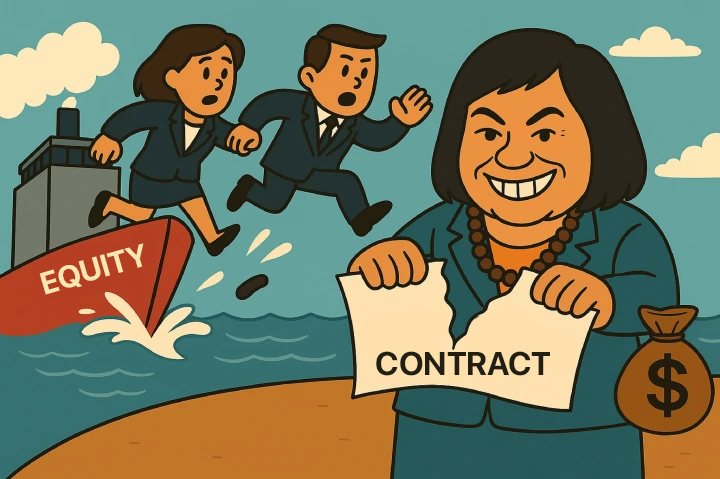
And a recent major case: In 2021, Ms. Pham Bich Nga signed a transfer contract for Hanoi Star School and the Hoang Mai Star School project to member companies of the EQuest Group (EQuest), with a clear commitment: after completing facility construction and obtaining an operating license (funded by EQuest’s money), she would hand over ownership of Hoang Mai Star School to EQuest. EQuest’s subsidiaries transferred the full amount of money to Ms. Nga as agreed.
However, after completion of construction and obtaining the operating license for Hoang Mai Star School, Ms. Nga abruptly declared a halt to cooperation, refused to hand over Hoang Mai Star School as committed, and even blatantly retained the entire sum of money. For nearly two long years, EQuest has been unable to recover either the money or the school, despite bringing the case to competent authorities.
All of the above deals were advised by top law firms in corporate law, both in Vietnam and internationally. But all contracts, agreements, and legal principles become meaningless if one party blatantly ignores the law and views challenging the law as a strategy to make money.
The common denominator in all such transactions is that domestic partners always attempt to push matters into “civil” territory and then utilize “home-field advantage” to drag out the situation or execute a “golden cicada shedding its skin” escape.
Swapping the concept of asset appropriation into a civil dispute poses a severe threat to the investment environment in Vietnam. It sends a message that any business owner can receive capital from investors, especially foreign ones, and subsequently find ways not to fulfill contractual obligations, refuse to return money to investors, and intentionally prolong time without fear of criminal prosecution.

PART 3: THEY LEAVE! AH YES, THEY REALLY LEAVE
(Why Do Investment Funds Usually Depart in Silence?)
“I realized one thing—a fund’s profit in Vietnam depends entirely on the grace of the founder.”
My friend Bob, former executive director of a multi-billion dollar investment fund where each deal deployed no less than $100 million, told me: “In Vietnam, I realized one thing—a fund’s profit depends entirely on decisions akin to favors granted by the founding boss. No matter which enterprise I invest in, or how large it is.”
This observation contains a troubling truth: certain enterprises and business owners continue to treat investors’ capital as though they are bestowing a favor upon the investor—rather than fulfilling a contract with legal and ethical obligations that must be strictly respected.
After more than six years of fruitlessly searching for investment opportunities in Vietnam, Bob quietly left. He resigned and moved to another company abroad—where the rules of the game are clearer, and trust is not a luxury.
A common question that is rarely answered directly: why do many investment funds throw in the towel or remain silent when disputes occur in Vietnam?
a) First Is Reputational Risk for the Fund Itself: “Exposing Them Loses Face for Us”
Most investment funds—especially global ones—are quite hesitant about public disputes due to fears of reputational damage in the host market. In many cases, they are even “deterred” with warnings that escalating the matter could lead to difficulties in administrative or legal procedures, or restricted market access. Risks to reputation and a hostile operating environment lead them to choose a quiet exit, accepting losses to preserve their image and focus on long-term strategy.
Some funds also worry that getting bogged down in prolonged litigation will hinder their next fundraising round—as unresolved legal files become “red flags” in the eyes of investment partners (Limited Partners).
However, while investors may remain silent in the media, they do not stay silent within the investment community. Behind-the-scenes stories about being cheated, betrayed, or treated unfairly spread rapidly through the global financial circle.
b) Second Reason: The Lifecycle of an Investment Is Short, While Litigation Time Is Too Long
An investment’s lifecycle typically lasts only 5–7 years. Meanwhile, the civil litigation process in Vietnam can drag on for 3–5 years, or even a decade if enforcement agencies lack resolve.
When time constraints no longer align with capital strategy, many funds choose to “swallow the bitter pill,” cut losses, recover whatever possible, and move on—rather than tying up capital in an indefinite legal battle.
In reality, disputes of this nature are being viewed as quite ordinary with an air of indifference. Because they cause no loss of life and no social shockwaves like mass frauds, unless there are special requirements, these cases seem frequently categorized as “difficult, exhausting, and non-urgent.”
c) Third Reason: International Awards Can Be Invalidated Right in Vietnam, So Why Waste Time?
Even when investors choose international arbitration seeking justice, the question remains: will that award be recognized in Vietnam? History shows it is uncertain.
The VMG – EPAY and Sojitz – Rang Dong cases mentioned above are two prime examples: international awards can be suspended or rejected at the investment destination. Global financial funds will inevitably ask: should they continue investing in a place where rules of the game are not guaranteed across borders?
d) Fourth Reason: Breach of Trust Goes Unpunished, So Fighting Yields the Same Outcome
In Vietnam, breaching contracts to appropriate investor funds often escapes severe punishment, and penalties are insufficient to deter offenders. Breaches of trust occur frequently, yet most are viewed through the lens of “civilization” to evade criminal processing, even when clear signs of fraud and asset appropriation exist. Dragging “civil” litigation cases go on endlessly, and ultimately the victim suffers double losses.
In countries that respect trust, even before turning to public authorities, people can use public opinion to boycott, “blacklist,” or refuse cooperation to punish violators. In Vietnam, the price for breach of trust and deception seems far too cheap, encouraging many to exploit it. At worst, a few years in prison. Or at worst, returning the money at a paltry interest rate, or even doing nothing at all.
We have witnessed similar dynamics in traffic, healthcare, and public health: when violations such as running red lights, manufacturing fake food, counterfeit medicine, or violating food safety carry only light fines, violators have no reason to stop. Only when sanctions are sufficiently strict and deterrent will wrongful acts truly cease.
In business, it is the same—when the price paid for breach of trust is too low, it becomes an attractive choice.
Indifference to these acts leaves cumulative consequences akin to slow-dripping poison or counterfeit medicine. No one dies instantly, but trust gradually erodes through every case that is not resolved thoroughly—until there is nothing left to lose, and the investment climate becomes rigid, discredited, and no longer attractive.
Yet no loss compares to the loss of trust. That is the invisible yet extremely heavy price the economy must pay.
PART 4: SOCIAL CAPITAL AND JUDICIAL REFORM
“This lingering grain of trust,
Why not hold it firm, instead of shattering it further?”
a) When Social Capital Depletes
When breach of trust goes without proper punishment, social capital drains away. In an economy where “social capital” drops low, every transaction becomes riskier, more complex, and more costly. Instead of relying on laws and contracts, people must rely on “relationships.” People only dare do business with those they trust because formal institutions are not strong enough to protect entrepreneurs and enterprises when they fall victim to costly legal violations.
When formal institutions gradually lose their role in protecting businesses and an underground, expensive, informal system takes over instead, people must spend more time developing social relationships, driving costs higher and innovation slower.
Francis Fukuyama, a famous American political scientist, declared in his classic book Trust: Social Virtues and the Creation of Prosperity that the more a country lacks social capital, the harder it is to develop large enterprises. Because the lack of social capital (trust in formal institutions) forces the state to intervene directly to a high degree, increasing transaction costs and reducing economic competitiveness.
Without changes and reforms in the judicial system, these behaviors will push Vietnam’s economy into a low equilibrium trap—where no one dares to innovate, and no one dares to invest boldly, because no one believes their efforts will be adequately protected.
It is time for Vietnamese enterprises to break free from “jungle law” conduct—where promises carry no weight and contracts can be torn up at whim. Instead, there is a need to build a business culture of the rule of law, upholding trust and fulfilling commitments as minimum principles in global integration.
b) Need for Judicial Reform Related to (Foreign) Investment
According to general evaluations, Vietnam possesses a fairly good legal framework, but enforcement efficiency remains limited. The asset recovery rate reaches only 25–40%, compared to 85–90% in Singapore. Resolution time takes 24–36 months, slower than Singapore’s 12–18 months.
Two of the “Four Pillars” Resolutions of the Politburo—Resolution 59-NQ/TW and Resolution 66-NQ/TW—have affirmed Vietnam’s determination regarding international integration and innovating law-making and enforcement work.
For the private sector to rise alongside the country as set forth by the Politburo’s resolution, it is time to think about a reform in the judicial sector related to (foreign) investment: starting with the establishment of an independent economic court with adequate professional capacity and effective enforcement capabilities compatible with international standards; judges need specialized training in economics and international commercial law, ensuring rulings are lawful, fair, and protective of legitimate rights, especially in complex or foreign-involved disputes;
The State should not dismiss foreign-involved economic cases or disputes as mere “civil” matters. These are issues with long-term impacts that can damage enduring trust and the economy’s capital mobilization capacity. The State needs to clearly define that protecting investor rights—especially foreign investors—is a strategic task requiring prioritized direction across the entire judicial, judgment enforcement, and administrative legal governance systems.
In reality, for major economic cases, most investors are willing to accept official costs at a reasonable level—provided the trial process is transparent, fair, and capable of swift enforcement.
Major funds—including sovereign wealth funds—typically cannot, and do not wish to, rely on “informal channels” to seek fairness and justice when disputes occur. Cases like those above are no longer private matters; resolving the questions raised serves as a litmus test of whether Vietnam truly uses the rule of law to protect foreign investors.
As an emerging economy full of potential with a young, educated population and a growing middle class, Vietnam’s prospects are currently evaluated positively by many investment funds. However, let us not be delusional: even for funds that accept high risks for high returns, preserving the principal investment amount remains top priority. They will not dare invest aggressively in an economy where the risk of losing principal capital rises. If they do, the cost of capital will increase significantly. And that would be an immense loss for the economy.
To restore trust and step-by-step establish and consolidate a modern, principled business culture, perhaps a campaign similar to the anti-corruption “blazing furnace”—this time to cleanse the investment environment—is needed: decisively settling pending violations, severely punishing fraud, breach of trust, and asset appropriation in business, and protecting investors, especially foreign ones.
And only then can we truly begin a genuine “rise.”
Nguyen Quoc Toan
(Thanks to the journalists, analysts, and lawyers who reviewed, provided information, and contributed feedback for this article).