
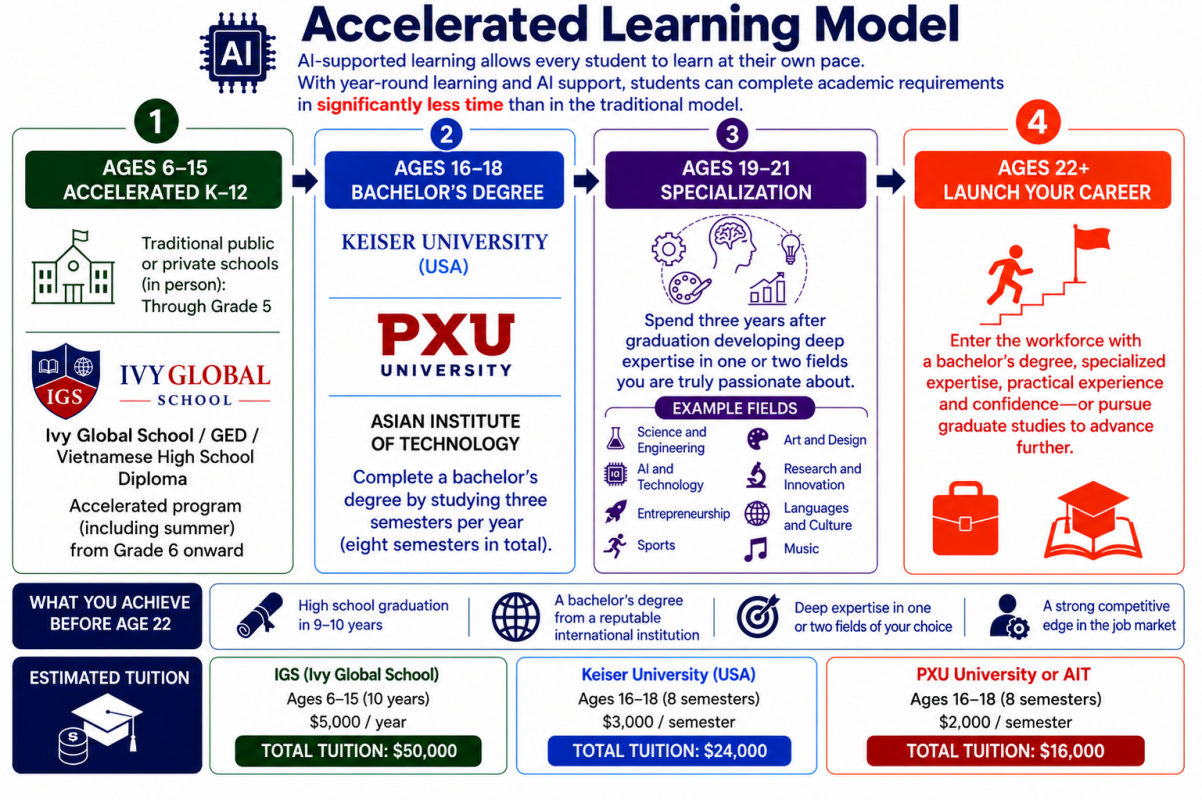
Accelerated learning pathway in the AI era: high school until around age 15-16, university for about three years, then three more years to study deeply and gain real work experience.
A few days ago, the US education and technology sectors were abuzz about the Andreessen Horowitz Academy, a new post-secondary education model replacing the traditional four-year university. The academy is run by a Udemy co-founder, with backing from the investment fund Andreessen Horowitz and many big names in the US tech industry.
The model is summarized as follows:
- High school graduates can choose the academy instead of university, learning about AI, business, and entrepreneurship through real-world projects.
- Success is evaluated based on the products and projects students create, rather than grades.
- Students solve practical problems, especially applying AI, and have the opportunity to work with businesses right during their studies.
- Tech partners support with resources, expertise, and connections for internship and job opportunities.
This is shocking news because of the backing from top names in the US technology field. Many experts in the education and tech communities assess that this model shows education – both high school and especially higher education – needs to change dramatically. As the cost of accessing knowledge becomes increasingly cheaper, students need to learn faster and solve practical problems sooner, instead of spending too much time following a traditional pathway.
To me, this model is very noteworthy and has great revolutionary potential. For many years now, we have pioneered the implementation of a nearly similar model. My view is that capable students should graduate high school early to enter real life and study something in depth. After that, whether they want to continue studying or go to work, they will have a better foundation. Therefore, I encourage capable students to aim for high school graduation around the age of 15-16.
You can accelerate your studies at Ivy Global School, our partner in the US; skip grades under the Vietnamese curriculum when eligible; or take the GED exam – a diploma equivalent to a US high school diploma – from age 16 when meeting regulations. Following that is a university pathway of about three years with suitable programs at PXU in collaboration with AIT or Keiser University, studying three terms per year and fully completing graduation requirements.
This means that by around age 18-19, you can already graduate from university. For the next three years, you can study a field in depth, pursue sports, conduct research, apply AI to solve business problems, launch a company (and fail a few times), or intern at multiple companies. Through this, you clearly understand what you want and what you can do. By around age 21-22, you will have the knowledge, expertise, and practical experience to enter the labor market with a huge advantage over the conventional pathway.
This model addresses parents’ concern about their children not graduating from university, while shortening a period that I think is very redundant for students who can learn faster. You gain a few extra years to master a field and become highly skilled, instead of having to wait until peers of the same age have just graduated from university to start.
The AI era does not allow us to keep groping in the dark forever. With AI, the cost of accessing high-quality knowledge is getting cheaper, and the learning opportunity gap between developed and developing countries can be narrowed very quickly. What pupils and students need is time to hone their skills and become proficient. Whatever you do, you must be decisive. Learning also needs to be personalized according to a student’s pace and capability, rather than being standardized and made to wait until age 18, followed by four more years of university. Too long and too standardized!
The Ministry of Education and Training and the Government of Vietnam should encourage and boldly pave the way for new educational models in the AI era, instead of establishing numerous regulations and over-controlling in detail. The world is changing very rapidly. If we continue to grope in the dark, remain conservative, and keep waiting for “trials,” we will turn around only to fall further behind.
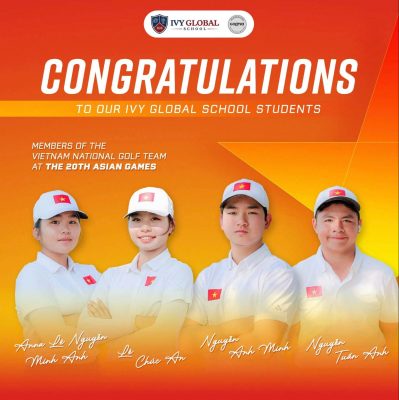
Four golfers participating in this year’s ASIAD are all students of Ivy Global School (US online school). Flexible online learning, their talent and boldness, along with the trust and commitment of their parents, have helped them reach peak sports performance.
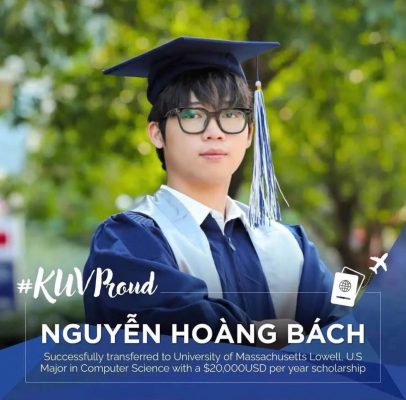
Nguyen Hoang Bach took the GED exam right after finishing 10th grade and is currently in his final year at the University of Massachusetts.